
 OBJECT
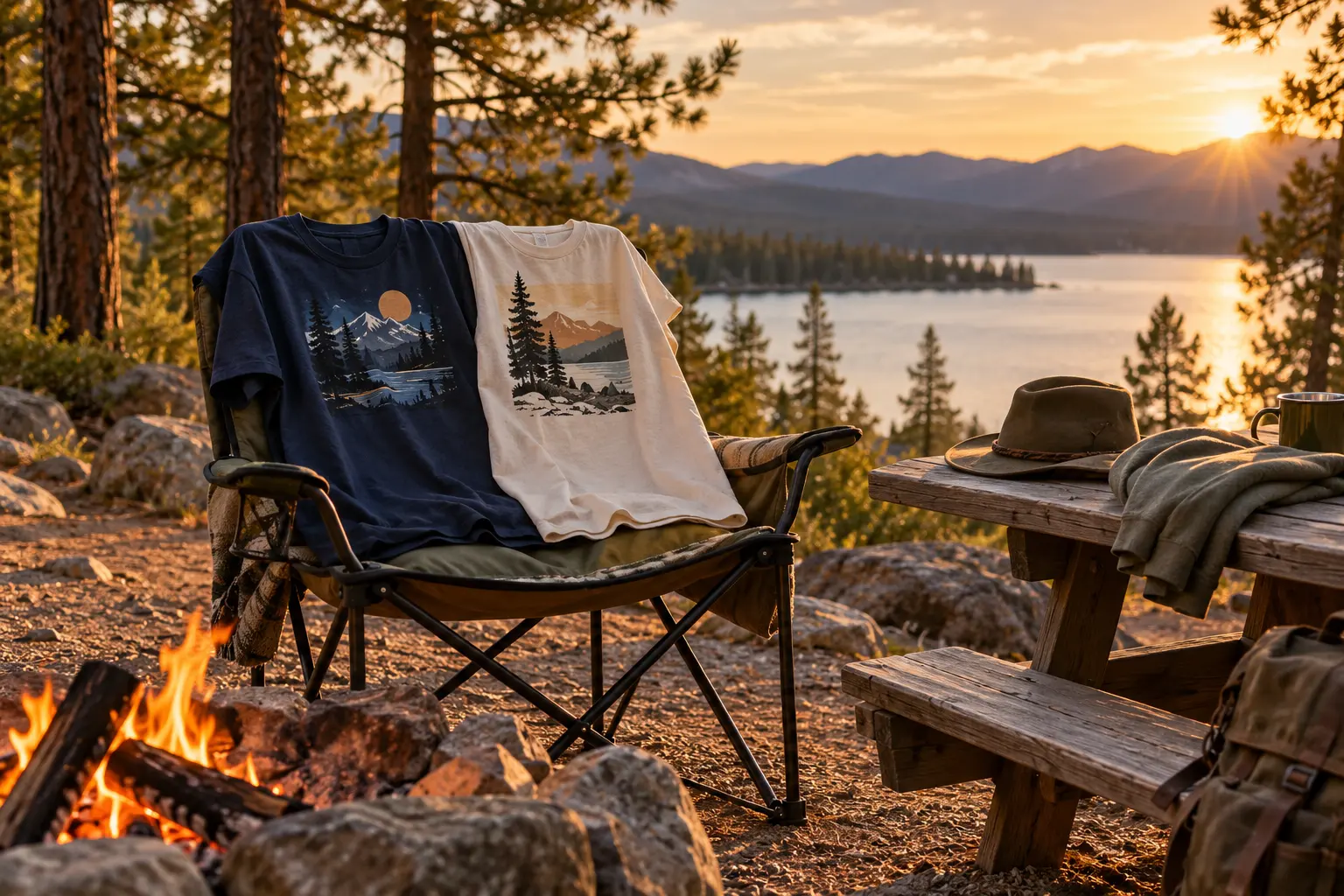
Deciding what to wear camping, graphic tees, hoodies and hats included, gets easier once you stop expecting every piece to do everything. A favorite printed tee is great to have at camp. Being soaked in it on a cold ridge at dusk is a different story.
So here is the rule this piece defends. A heavyweight cotton graphic tee is your camp and downtime shirt in mild, dry weather. Something else goes against your skin when it’s cold, wet or sweaty. Color is a separate decision, and it involves a real tradeoff between spotting ticks and blocking sun. Hats and hoodies each solve a narrower problem than most packing lists admit. The sections below take these decisions one at a time and finish with the unglamorous part: washing a printed shirt after a weekend outside.
What to wear camping starts with giving each piece one job
Outdoor clothing advice usually comes in layers. The base layer sits against your skin and manages sweat. The middle layer holds warmth. The outer layer blocks wind and rain. Once the weather turns, a graphic tee doesn’t fit cleanly into any of those roles. It does well at a fourth job nobody writes down: the shirt you wear while the coffee brews, the fire burns and nobody is climbing anything.
That gives you a simple decision rule. If the forecast is mild and dry and your plans stay close to camp, the cotton tee can be your main shirt all day. Think fishing off the dock, a short flat walk or cards at the picnic table. If the forecast includes cold nights, rain or a long, sweaty climb, the tee becomes the shirt you change into back at camp, not the one you hike in.
Three hypothetical trips, three answers
- A lakeside car-camping weekend with warm afternoons. Wear the tee all day. Pack a sweatshirt or hoodie for the evening temperature drop and a wide-brim hat for the hours on open water.
- A fall trip with rain in the forecast and a hike to a viewpoint. Hike in wicking layers under a rain shell. Keep the graphic tee dry in your pack and put it on once you’re back under the tarp.
- A gift for a camper who lives with cats. A cat graphic is an obvious fit. Base the color on where they camp, and know one permethrin caveat before you suggest treated clothing. Both are covered below.
The shirt is the same in all three scenarios. What changes is its job. You’re not deciding whether a graphic tee is good for camping. You’re deciding which hours of the trip it covers, and that decision shapes everything else in the bag.
It also takes pressure off the purchase. You don’t need a shirt that does everything. You need one you’re happy to wear in the hours it suits, and enough other layers to cover the rest.
Cotton graphic tees at camp: what the fabric does well and badly
Two of the tees discussed here are listed on the Heavy Cotton 5000 blank. The third lists a Heavy Cotton size chart. lists the 5000 at 5.3 ounces per square yard [1]. Its solid colors are 100% U.S. cotton [1]. Some colors are blends. lists Sport Grey as 90% cotton and 10% polyester [1], and its heather and safety colors as 50% cotton and 50% polyester [1].
The blank’s construction matters more at camp than you’d think. specifies taped neck and shoulders for comfort and durability [1]. The label tears away [1]. The cut is described as a classic fit for loose comfort [1]. In practice, a removable label means nothing scratches the back of your neck under a pack strap or a sweatshirt hood. Taped shoulder seams are the kind of detail that holds up to being stuffed into a duffel and pulled on in a cramped tent.
The wet-cotton problem
Cotton fiber absorbs water. That’s part of why it feels pleasant on a dry, warm afternoon. The same trait means a cotton shirt that’s soaked with sweat or rain stays wet against your skin and keeps drawing heat from your body as it slowly dries. Park safety guidance is blunt about this. Rocky Mountain National Park advises avoiding clothing that absorbs and holds water, like cotton and jeans [3]. The park recommends wicking layers you can add or remove as conditions change [3]. It also warns that hypothermia can happen year-round, even on nice sunny days [3].
For a dry chuckle: pitches the tee as going with jeans, shorts and sweats [1]. On a cold, wet trail, the park service would advise against the jeans part.
Do blends change the verdict?
A 50/50 heather does contain synthetic fiber, so it’s tempting to assume it behaves like an athletic shirt. Nothing in the manufacturer’s listing makes that claim. A blended everyday tee is still an everyday tee, not a tested base layer. Treat all three shirts the same way.
- Good at: lounging around camp, short easy walks in dry weather, warm evenings, the drive home.
- Not built for: next-to-skin wear on long climbs, rainy days, cold nights or anywhere you can’t change into something dry.
- Easy fix: keep one tee in a zip bag so a dry shirt is waiting at the end of a wet day.
Light or dark graphic tees for camping: ticks versus sun
This is the decision people get wrong in both directions. One rule says wear light colors in the woods. Another says wear dark colors in the sun. Both are correct, about different hazards, and no single tee color covers both.
Light-colored clothing makes ticks easier to spot [8]. Dark or bright colors absorb UV rays instead of letting them through, so they protect better than lighter shades [6]. A white T-shirt offers only moderate sun protection, with a UPF of about 7 [6]. Once that shirt gets wet, its UPF drops to about 3 [6]. For comparison, the Skin Cancer Foundation rates UPF 30 to 49 as very good and UPF 50 and above as excellent [6].
None of the tees here carry a UPF rating. Color helps you decide which hazard to prioritize. It doesn’t turn a fashion tee into sun-protective clothing.
| Color group | Example colors in this lineup | Works in your favor | Falls short on | Best camp use |
|---|---|---|---|---|
| Light | Natural, White, Light Blue, Sport Grey Heather (“Try To See What Is Unseen”) | Crawling ticks are easier to see | Lets more UV through than dark shades | Wooded or grassy sites, shady campsites, tick checks |
| Dark | Navy, Black, Forest Green, Maroon (“Don’t Tell Me What To Do”) | Absorbs more UV than light shades | Ticks are harder to spot against it | Open, sunny sites, docks, beaches, evenings |
| Mixed range | Black, Navy, Cardinal Red, Dark Heather, Sand (“I Mend What I Mean to Keep”) | Lets you choose per trip | Each color still has only one strength | One design, different color for each trip |
| Any color, wet | Every shirt here | Nothing extra | Sun protection drops, and cotton holds water | Change into a dry shirt |
Editorial judgment: if your usual campsite is wooded, brushy or grassy, choose a light color and handle sun with a hat, shade and sunscreen. If you camp mostly on open water or exposed ground, go darker and be more deliberate about tick checks.
A light-color pick for wooded sites
“Try To See What Is Unseen” comes only in lighter shades: Natural, White, Sport Grey Heather, Light Blue and Gold. The art is built on contrast. Coral-red block lettering with navy edges and shadows runs in four compact rows. A chubby teal-and-black cat sits among stars, open eyes, question marks and a wireframe cube. It’s a good shirt for the camper who likes nights of stargazing and campfire conversations that drift into odd theories. The slogan also suits an evening spent checking each other for ticks. Sizes run S through 5XL. If fiber content matters to you, check the listing for Sport Grey Heather’s blend before ordering. The name suggests Gildan’s Sport Grey, but the catalog doesn’t confirm it.
One detail worth knowing: the Skin Cancer Foundation notes that unbleached cotton contains natural lignins that absorb UV [6]. A color called Natural doesn’t tell you whether the cotton was bleached, so don’t read the color name as a protection claim.
When a dark graphic tee is the better camp shirt
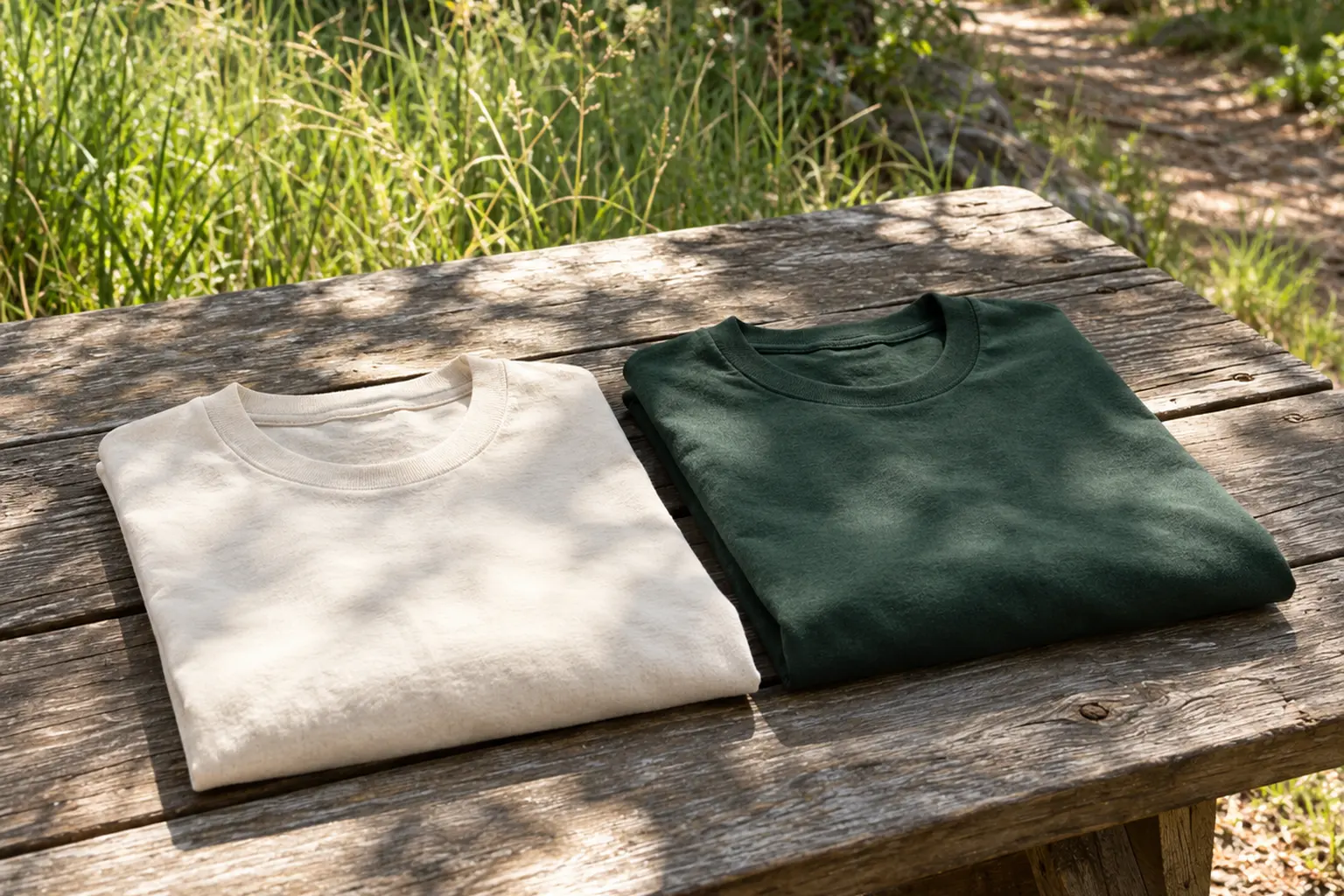
Dark tees make the most sense in sunny, open places: a gravel pad with no tree cover, a beach site, a long afternoon on a dock. In those settings, color is working for you. Two other factors from the same sun-safety guidance matter just as much.
The first is fit. The Skin Cancer Foundation prefers loose-fitting clothing, because tight clothing stretches and lets more UV through as the fibers pull apart [6]. A classic, loose cut at least avoids that problem, which is one more reason to size for comfort rather than a snug fit. The second is coverage. The same source recommends long sleeves and long pants or skirts whenever possible [6]. A short-sleeve tee leaves your forearms and neck exposed no matter its color. If you spend whole days in open sun, a long-sleeve shirt covers more skin than any short-sleeve tee can.
A dark pick for the angler or the contrarian
“Don’t Tell Me What To Do” comes only in dark colors: Navy, Black, Forest Green and Maroon. These read as solid colors, which lists as 100% cotton on this blank [1]. The listing is still the final word for the color you choose. The artwork is a small, stubborn scene. An orange tabby covers its eyes with cream-and-orange paws while gripping a fish held straight across its face. Cream serif lettering with black outlines and distressed strokes frames the cat. A curled black ribbon carries the last words, with gold-edged starbursts filling the gaps.
Who it suits: the camper who refuses to follow the itinerary, anyone who fishes, and cat people who know the fish isn’t coming back. It also works as a gift for the person in your group who always gets the best spot by the fire. Sizes run S through 5XL.
What a dark tee won’t do
- It isn’t UPF clothing. Wear sunscreen and a brimmed hat as usual.
- Once it’s wet from a swim or sweat, it loses part of the protection it had [6].
- In grassy or brushy areas, ticks are harder to spot on it, so do a slower, more careful check at the end of the day.
A practical routine many campers fall into: wear the dark tee during the bright middle of the day near the water, then switch to a lighter shirt or a covered layer before evening walks through tall grass. You’re adjusting to the setting, not arguing with it.
Hoodies and sweatshirts at camp: where the middle layer fits
Temperatures drop quickly once the sun goes behind the trees, and that’s when a hoodie or crewneck sweatshirt becomes the most useful thing you packed. At camp, its job is warmth over a dry tee while you’re sitting still. It isn’t a rain layer, and if it’s cotton-rich, it has the same wet-cotton problem as the tee underneath.
Park guidance treats the outer layers as non-negotiable. Rocky Mountain National Park says to always pack a jacket suited to the expected conditions [3]. It also says to always pack a waterproof or rainproof layer [3]. A sweatshirt is a comfort layer between those two, not a replacement for either.
How to choose one for camp
- Read the fiber tag. Heavy cotton is cozy on a dry night by the fire. For a damp trip, a layer with more synthetic or wool content is the better middle layer. Check the label rather than assuming from the look.
- Size it over a tee. A classic-fit tee under a sweatshirt can bunch at the shoulders if both are sized tightly. Compare chest measurements on both size charts, not just the letter size.
- Hood or no hood. A hood helps on a windy shoreline and keeps a beanie in place. A crewneck sits more cleanly under a jacket collar. Decide based on whether you’ll wear it alone or layered.
- Keep it dry. Pack it in a separate bag. A sweatshirt that soaks up tent condensation won’t help much at 10 p.m.
This is also where a graphic tee’s print placement starts to matter. If you’ll wear a zip hoodie open over a tee, a center-chest design stays visible. A crewneck sweatshirt covers it completely. Neither is better, but if the shirt is a gift meant to be seen, plan the layer on top accordingly.
If you’re putting together a matching camp set, the sweatshirts section is the place to start. Use the same rule: pick the fiber for the forecast and the graphic for the person.
Camping hats: wide brim for sun, beanie for cold, cap for everything else
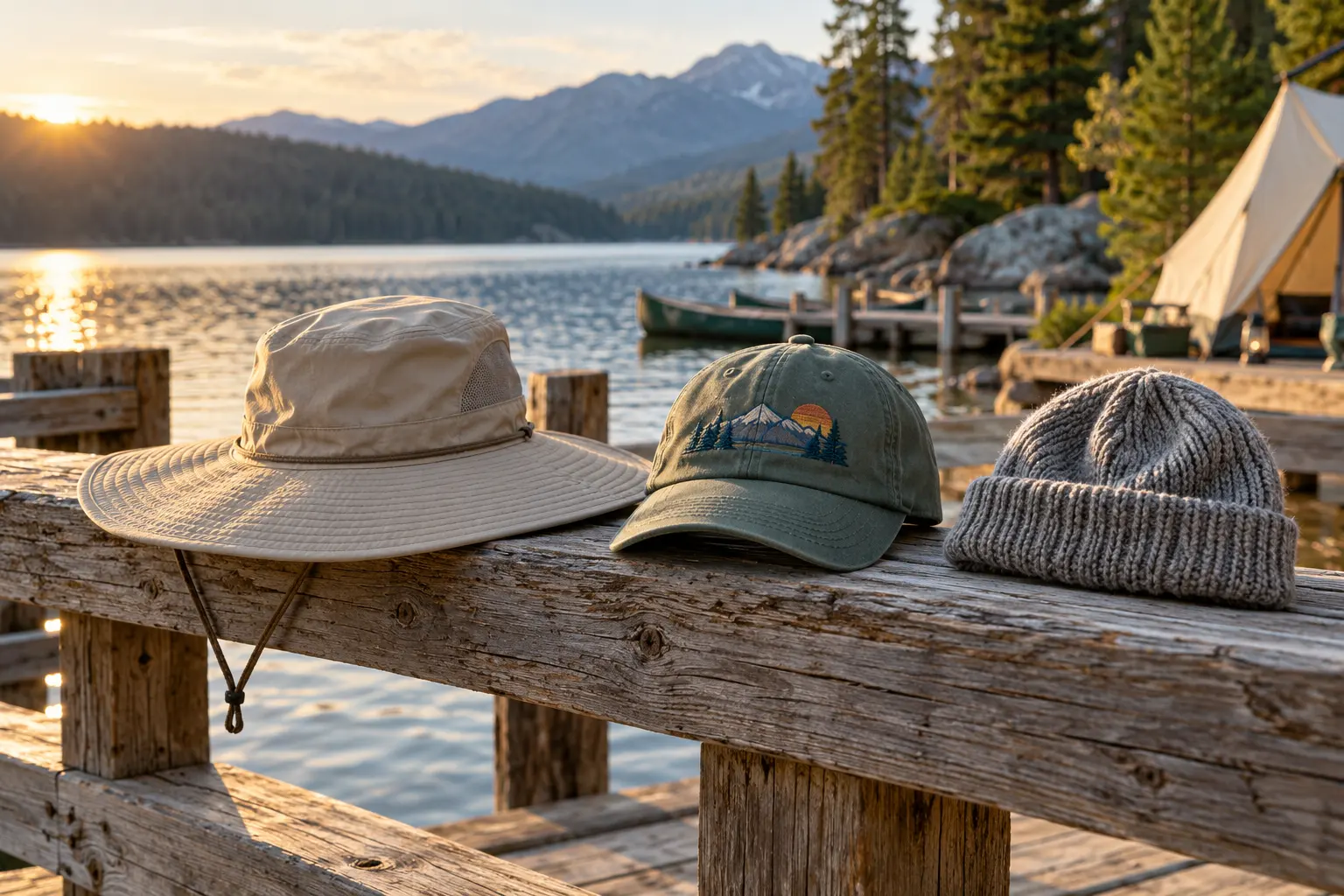
Hats get one line on most packing lists. They need two or three, because the hat that handles midday sun isn’t the one that keeps your head warm at night, and a baseball-style cap does neither fully.
For sun: brim width is the specification
The Skin Cancer Foundation recommends a brim of at least three inches to shade the face, scalp, neck and the easily missed tops of the ears and back of the neck [6]. It also recommends a tightly woven hat over a loosely built straw one that lets UV through [6]. By that standard, a front-brim cap shades your forehead and eyes but leaves your ears and the back of your neck exposed. That conclusion follows directly from the brim guidance, not from any test of a particular hat.
Editorial judgment: if you spend long hours on a lake or an exposed site, a full wide-brim hat is the right tool, and a cap is a backup.
For cold: pack the beanie even in summer
Rocky Mountain National Park advises packing a warm winter hat, warm gloves and extra wool socks even during summer [3]. High campsites cool off fast, and a knit hat is the lightest warmth you can carry. Check the fiber content before you count on one for a wet trip. The same water-absorption logic from the cotton section applies here.
For ticks: a hat is part of covering up
UCLA Health’s tick advice includes wearing a hat and covering your neck in tick habitat [8]. Any hat helps here, though it does nothing to replace a tick check at the end of the day.
Where an embroidered cap belongs
- Around camp, on the drive, at the gas station and the diner afterward.
- Under a hood on a breezy evening, where the brim keeps drizzle off your face.
- As a gift, where it shows a hobby or a joke without requiring a garment size.
What it shouldn’t be is your only sun protection on a bright day. Pair a cap with sunscreen on your ears and neck, or carry a wide-brim hat for the hours you’ll actually be in full sun.
Ticks, permethrin and a caution for cat owners
Late-season camping is not tick-free. The CDC notes that ticks are most active in warmer months, April through September, but exposure can happen year-round [7]. Ticks live in grassy, brushy or wooded areas, and camping is one of the activities the CDC lists as bringing people into contact with them [7].
What the guidance recommends
- The CDC recommends treating clothing, boots and camping gear with products containing 0.5% permethrin [7].
- Treated items stay protective through several washings, and pre-treated clothing is available to buy [7].
- On skin, the CDC recommends EPA-registered repellents such as DEET, picaridin, IR3535, oil of lemon eucalyptus, PMD or 2-undecanone [7].
- If you use sunscreen too, the CDC says to apply sunscreen first and repellent second [7].
- UCLA Health advises tucking your shirt in and tucking pant cuffs into your socks [8].
Permethrin goes on clothing only. UCLA Health says it should never be applied directly to your body because it can irritate skin [8]. The same source warns that cats are sensitive to permethrin and that even low concentrations can cause health problems [8].
The cat-owner version of the plan
That last point matters for anyone browsing animal and pet designs, because two of the tees here feature cats and are likely headed to cat households. Editorial judgment for those buyers:
- Follow the permethrin product label closely, including drying instructions, and do the treating away from where your cat goes.
- Keep treated gear stored where the cat can’t sleep on it. Cats tend to choose a duffel full of clothes as a nap spot.
- If you’d rather not bring permethrin home at all, rely on skin repellent, light colors, tucking in and thorough checks.
What about your graphic tee?
There’s no good evidence either way on whether home permethrin treatment affects a printed graphic. Given that uncertainty, a reasonable approach is to treat the plain layers that do most of the blocking, such as socks, pants and an overshirt, and wear the graphic tee tucked in underneath. The classic loose fit leaves enough length to tuck. Treat your favorite artwork as something to show off at camp, not tick-prevention gear.

After the trip: washing a printed camping tee without ignoring ticks
This is where two good sets of advice conflict. Printed tees generally last longer with gentle care: inside out, cool water, low heat or line drying. Tick guidance calls for high heat. You don’t have to choose one or the other if you follow the steps in the right order.
The CDC says to tumble dry clothes on high heat for 10 minutes to kill ticks on dry clothing after you come indoors [7]. Damp clothes may need longer [7]. If you wash first, the CDC recommends hot water, because cold and medium temperatures won’t kill ticks [7].
A sequence that respects both
- Check the shirt for ticks as soon as you take it off, and remove any you find.
- If you were in tick habitat and the shirt is dry, run it on high heat for the 10 minutes the CDC describes. Do this before washing, so you don’t need a hot wash.
- Then wash it inside out in cold water on a gentle cycle, following the care instructions included with your order.
- Hang it to dry or tumble dry on low, and never iron directly over the print.
No source quantifies how much one short high-heat cycle affects a print. So the tradeoff is real but limited: a small, uncertain amount of wear on the graphic in exchange for not bringing ticks into the house. If you stayed on a paved site and never went near tall grass, skip step two.
A tee whose message is about keeping things
“I Mend What I Mean to Keep” suits the camper who repairs a tent pole instead of replacing it and saves the patched flannel for one more season. The art is a folk-style quilt panel with pear-shaped fruit, stitched vines and dashed thread lines between patches. A long needle trailing red thread hooks through the border. Above it, condensed serif lettering in navy, red and cream has deep drop shadows. A scalloped ribbon reading “Household Textile Guild, Est. 1936” sits beneath the quilt as part of the design. Colors are Black, Cardinal Red, Navy, Dark Heather and Sand, in sizes S through 5XL. Sand gives you a lighter option for wooded sites, and Navy or Black covers sunny ones. The listing’s size chart references a Heavy Cotton tee but doesn’t confirm the exact model. If the blend matters to you, especially for Dark Heather, check the listing first.
Your next decision: size before color
Before you choose a color, settle the size. Shrinkage isn’t confirmed either way on the current manufacturer page. Measure a tee you already like and compare it to the size chart using the method in the unisex graphic tee sizing guide. Allow some room if you plan to wear the shirt tucked in or under a sweatshirt. Then choose the color for where you actually camp: lighter for woods and grass, darker for open sun.
Frequently Asked Questions
Is it okay to wear a cotton graphic tee camping?
Yes, for mild, dry hours around camp, a cotton tee is a perfectly good shirt. The problem is wearing it when it's likely to get wet from rain or sweat in cool weather, because cotton absorbs water and holds it against your skin. Rocky Mountain National Park recommends avoiding clothing that absorbs and holds water, like cotton and jeans, and choosing wicking layers [3]. Hike in those layers and change into the graphic tee once you're back at camp.
Should I wear light or dark colors when camping?
It depends on the bigger hazard. Light colors make ticks easier to spot, which helps on grassy or wooded sites [8]. Dark or bright colors block more UV than light shades, which helps on open, sunny ground [6]. No single tee color does both well, so choose for your usual campsite and use other measures for the second risk.
Does a dark T-shirt count as sun protection?
Not on its own. A dark shirt absorbs more UV than a light one, but an unrated everyday tee isn't UPF clothing, and wet fabric loses some of its protection. The Skin Cancer Foundation reports that a white tee measures around UPF 7, dropping to about 3 when wet [6]. For long days in full sun, add a wide-brim hat, sunscreen and long sleeves.
Is a baseball cap enough of a hat for camping?
It's fine for errands and time in the shade, but it doesn't cover everything sun-safety guidance asks for. The Skin Cancer Foundation recommends a brim of at least three inches to shade the face, ears and back of the neck [6]. A front-brim cap leaves your ears and neck exposed, so pair it with sunscreen or bring a wide-brim hat for exposed hours. Pack a warm knit hat for cold nights too.
How do I wash a graphic tee after camping in tick country?
Check the shirt for ticks first. If it's dry, tumble it on high heat for 10 minutes, which the CDC says kills ticks on dry clothing [7]. Then wash it inside out in cold water on a gentle cycle and dry it on low or hang it, following the care instructions included with your order. Doing the heat step first means you don't need a hot wash.
Can I treat my graphic tee with permethrin?
Permethrin is meant for clothing and gear, never skin, and the CDC recommends products with 0.5% permethrin [7]. There's no clear evidence on how home treatment affects a printed graphic, so many campers treat plain socks, pants and overshirts instead and tuck the tee underneath. If you live with cats, be extra careful, since UCLA Health warns cats are sensitive to permethrin even at low concentrations [8]. Follow the treatment product's label for application and drying.