
 OBJECT
A unisex graphic tee sizing guide for men and women has to solve one awkward problem: the same letter is supposed to fit two differently shaped groups of people. You wear a medium in most things. Does that mean a unisex medium, a small, or a large if you want it roomy?
Here’s the short answer. Stop choosing by letter and choose by one number, the chest width of a tee you already own and like, then check length second. Men generally land in their usual size. Women usually have two good options rather than one: the same letter for a relaxed fit, or one size down for a closer fit, provided the hem still clears the hips. Everything below explains why that rule holds, where it breaks, and how a sweatshirt changes the math.
What Unisex Really Means on a Graphic Tee
Unisex is not a third body shape. In practice it is a single pattern, typically graded from a men’s measurement table, sold to everyone. That matters because the pattern makes a few assumptions, and those assumptions are where fit surprises come from.
The four things a unisex cut assumes
- Straight side seams. The body drops from armpit to hem in a more or less straight line. No waist shaping, no flare at the hip. The hem is about as wide as the chest.
- Wider shoulders. The shoulder seam is placed for a broader frame, so on narrower shoulders it slides down the arm. Depending on how far, that reads as a deliberate drop shoulder or as a shirt that’s too big.
- Longer, looser sleeves. Sleeves tend to end closer to the elbow than on a women’s-cut tee, with a wider opening.
- A longer body. Length is graded for a longer torso, which can be a feature (tuckable, covers the waistband) or a nuisance (bunches at the hip).
None of this is a flaw. A straight, boxy body is the friendliest shape for a big front graphic, because the print lies on a flat panel instead of being pulled around curves. It’s just a different garment from a fitted women’s tee that happens to share a size letter.
The other thing worth knowing: size letters aren’t locked to one set of inches. A medium from one blank can be noticeably wider or longer than a medium from another, which is why two mediums in your drawer don’t stack neatly. The letter is a label. The measurement is the fact.
All six designs discussed here are sold on unisex crewneck blanks: three on a Heavyweight Unisex Crewneck T-shirt listed in S through 5XL, and three on a Heavy Blend Unisex Crewneck Sweatshirt listed in S through 3XL. Notice the bottom of both ranges. The smallest size is S, and that single detail changes the advice for smaller-framed shoppers more than anything else, as the women’s section explains.
Measure a Tee You Own: The Three Numbers That Decide Fit
Body measurements tell you about you. Garment measurements tell you about the shirt, and the shirt is what you’re buying. The fastest, most reliable method is to measure a tee you already like and match it.
How to take the measurements
- Lay it flat. Stretch nothing. Smooth the shirt on a table or bed, front side up.
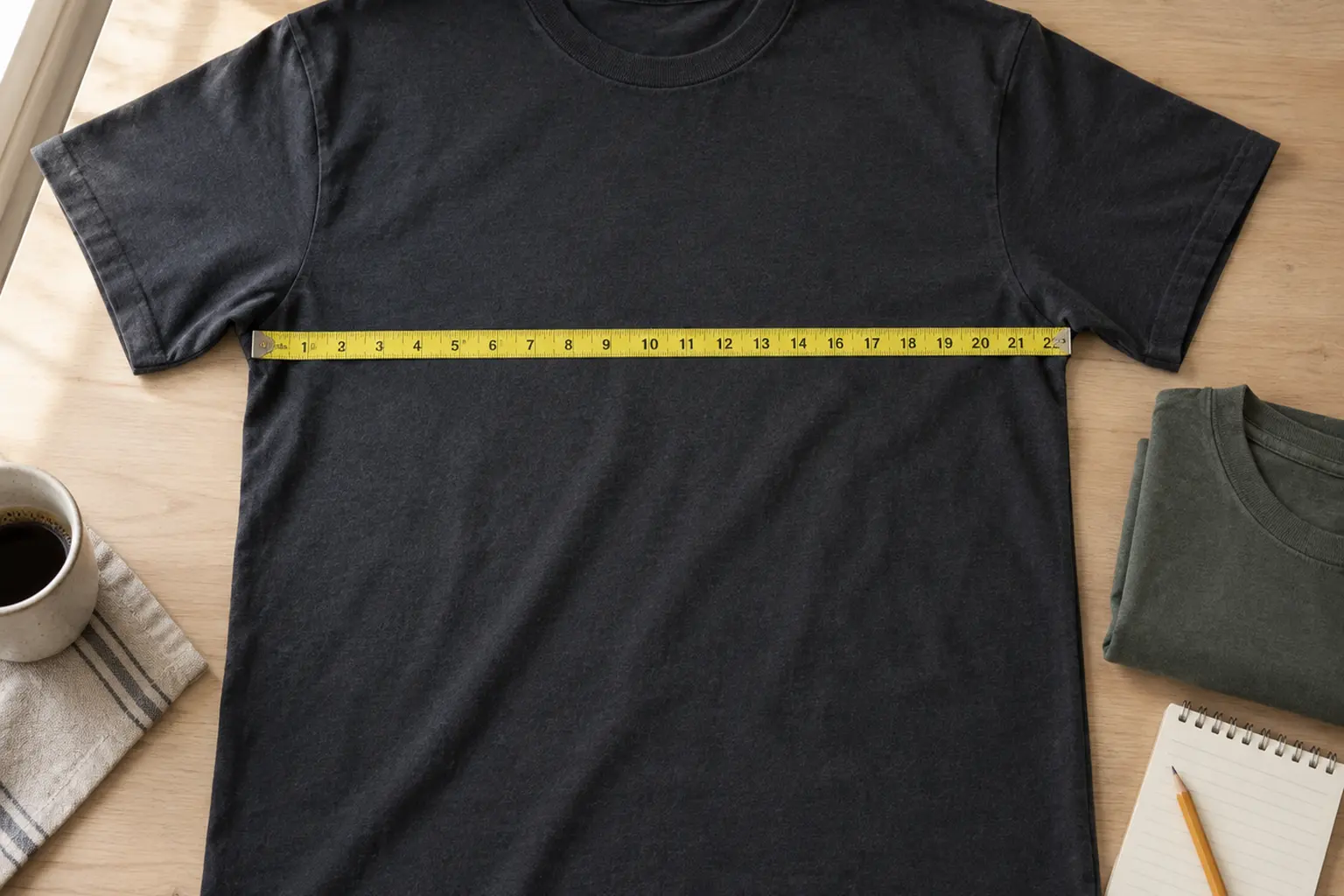
- Chest width. Measure straight across from armpit seam to armpit seam. This is often called pit-to-pit. It is half the chest circumference, so a shirt 20 inches across is 40 inches around.
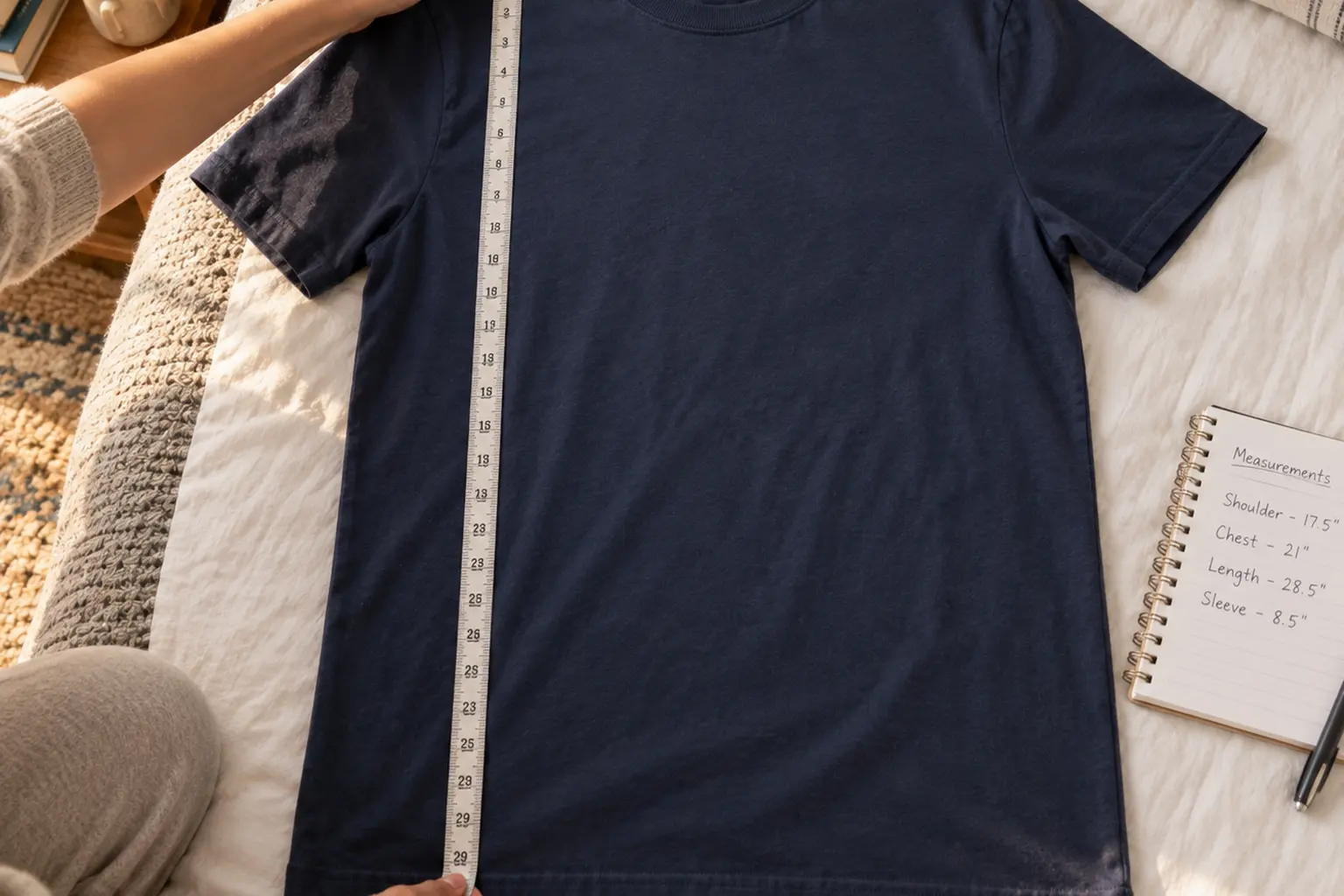
- Body length. Measure from the highest point of the shoulder, right where it meets the collar, straight down to the hem.
- Shoulder and sleeve, if you care. Shoulder seam to shoulder seam across the back, and sleeve from seam to edge. Optional, but useful if dropped shoulders bother you.
Now compare those numbers to the garment measurements on the product page. Pick the size whose chest width is closest to your favorite shirt. If you fall between two sizes, length is the tiebreaker.
Why chest width goes first
Because it’s the one dimension you can’t fudge. A shirt that’s an inch long can be tucked, and a sleeve can be rolled. A shirt that’s too narrow across the chest pulls at the armholes, rides up, and stretches the graphic sideways. Too wide by a lot, and the shoulders collapse.
How much room is right depends on what you’re after. A useful way to think about it is ease, the difference between your own chest circumference and the shirt’s:
- Closer fit: the shirt is only a few inches bigger around than you are.
- Regular fit: clearly loose, but the shoulder seam sits near your shoulder point.
- Oversized: the shoulder seams drop off the shoulder and the body hangs away from you.
Those are shapes, not sizes, and the distinction matters. If you want a deliberately roomy look, read up on choosing between an oversized and a regular fit before you simply add two sizes, since going up changes length and sleeve as well as width.
One caveat, stated once: exact inches vary by blank and by production lot, so use the chart on the specific product page rather than a generic one. If a listing shows only letters, measure your own tee anyway. You’ll at least know which direction you tend to run.
Unisex Tee Sizing for Women: Same Size or One Down?
The common advice is that women should size down one in unisex. It’s half right. Sizing down narrows the chest and shoulders, which is what most people want. It also shortens the body and, because the side seams are straight, narrows the hem by the same amount. That last part is where it backfires.
The hip check
A unisex tee is about as wide at the hem as at the chest. If your hips measure larger than your bust, a size chosen to fit your chest closely can catch at the hip and ride up when you move. So before sizing down, compare the shirt’s circumference (chest width doubled) to your hip measurement at the point where the hem will land. If the shirt isn’t at least a little bigger than you there, stay in your usual letter.
Three situations, three answers
- If you usually wear a women’s medium and want a neat, closer fit, with hips no wider than your bust, a unisex small is the likely match. Confirm against your own tee’s chest width.
- If you usually wear a women’s medium and want the relaxed, slightly slouchy look, or plan to half-tuck, order the unisex medium. The extra length is what makes a tuck stay put.
- If you usually wear a women’s small or extra-small, there’s nowhere to go down. These tees start at S. A unisex small will fit you as a relaxed or oversized tee, full stop. That can look great with the sleeves rolled once and the front tucked, but it won’t be fitted, and it’s better to know that before ordering.
A fuller bust pushes the calculation the other way. Fabric used up across the chest lifts the front hem, so a size that measures fine on paper can read short in front. In that case keep your usual letter, or go up, and let the straight body hang.
What the graphic adds to the decision
Dense artwork behaves differently from a small chest logo when a shirt is snug. The Thorns Around the Open Shears design is a good example. The catalog describes a graphite-style rose and open shears with bold serif lettering across the top, spiked text along both sides and compressed print at the base, leaving almost no background exposed. A composition that fills the panel edge to edge wants a flat surface. Sized for a closer fit over a curvier frame, the side lettering starts to wrap toward the ribs. Sized relaxed, it reads the way it was drawn.
That shirt is listed in Black, Garnet, Dark Heather, Navy and Forest Green, in S through 5XL, so both the same-size and size-down routes are open to most shoppers.
A practical note on wearing a relaxed unisex tee with what’s already in your closet: a single sleeve roll shortens the visual sleeve to something closer to a women’s cut, and a front tuck handles most of the extra length. Neither requires a different size.
Unisex Tee Sizing for Men: True to Size, With Three Exceptions
For most men, this is the easy half. The pattern is built on the proportions you already buy, so your usual tee size is the right starting point. Measure a favorite shirt to confirm, then order that letter.
The exceptions are worth a minute, though, because they account for most of the disappointments.
1. You’re tall or long in the torso
Sizes tend to grow wider faster than they grow longer. If your usual size fits your chest but shows waistband when you reach up, going up one may get you a little length and a lot of width. Check the length figure for both sizes. If the gain is small, the bigger shirt won’t solve the problem, and your drying habits (covered below) will matter more than the letter.
2. You carry weight in the midsection
Fit the widest part of you, not the chest. Straight side seams mean the shirt’s circumference at the belly is roughly its chest circumference. Measure around your middle and choose the size that leaves a few inches to spare there. The shoulders may sit a touch wide. That’s a far better trade than a hem that climbs.
3. You’re broad through the shoulders and chest
Lifters and wide-framed guys often find the chest number works while the sleeves and armholes bind. If your favorite tee is one you bought a size up for exactly this reason, trust the tee, not your nominal size.
Range matters here too. Plenty of graphic tees stop at 2XL or 3XL, which leaves bigger men guessing or giving up. The three tee designs in this lineup are listed through 5XL. The Bulldog Beef Graphic tee, printed on a Gildan 5000 heavyweight crewneck, comes in Forest Green, Black, Navy and Maroon across the S to 5XL run.
The artwork is a busy one: a forward-facing bulldog in a black shirt with chipped orange Beef lettering, pale Cook capitals filling the upper half, and a double-decker bus, steaks and a telephone box worked in around it. With that much going on, a size that sits flat across the chest and stomach keeps the densely layered lower half readable instead of stretched.
If you’re weighing this blank against thinner tees you already own, the piece on how a heavyweight tee differs from a standard one in silhouette explains why a heavier jersey tends to hang straighter and read a bit boxier in the same size.
Tee vs. Crewneck Sweatshirt: Why the Same Letter Fits Differently
Buying the tee in large doesn’t guarantee the sweatshirt should be a large. They’re different fabrics, finished differently at the edges, and worn over different things.
The sweatshirts here carry the Heavy Blend crewneck name. The manufacturer’s page for that adult crewneck style lists the fabric at 8.0 oz/yd² in a 50% cotton, 50% polyester blend for solid colors, with heather shades at 40% cotton and 60% polyester [2]. The same page describes the cut as a classic fit for loose comfort, with rib cuffs and a bottom band that include spandex for stretch and recovery [2].
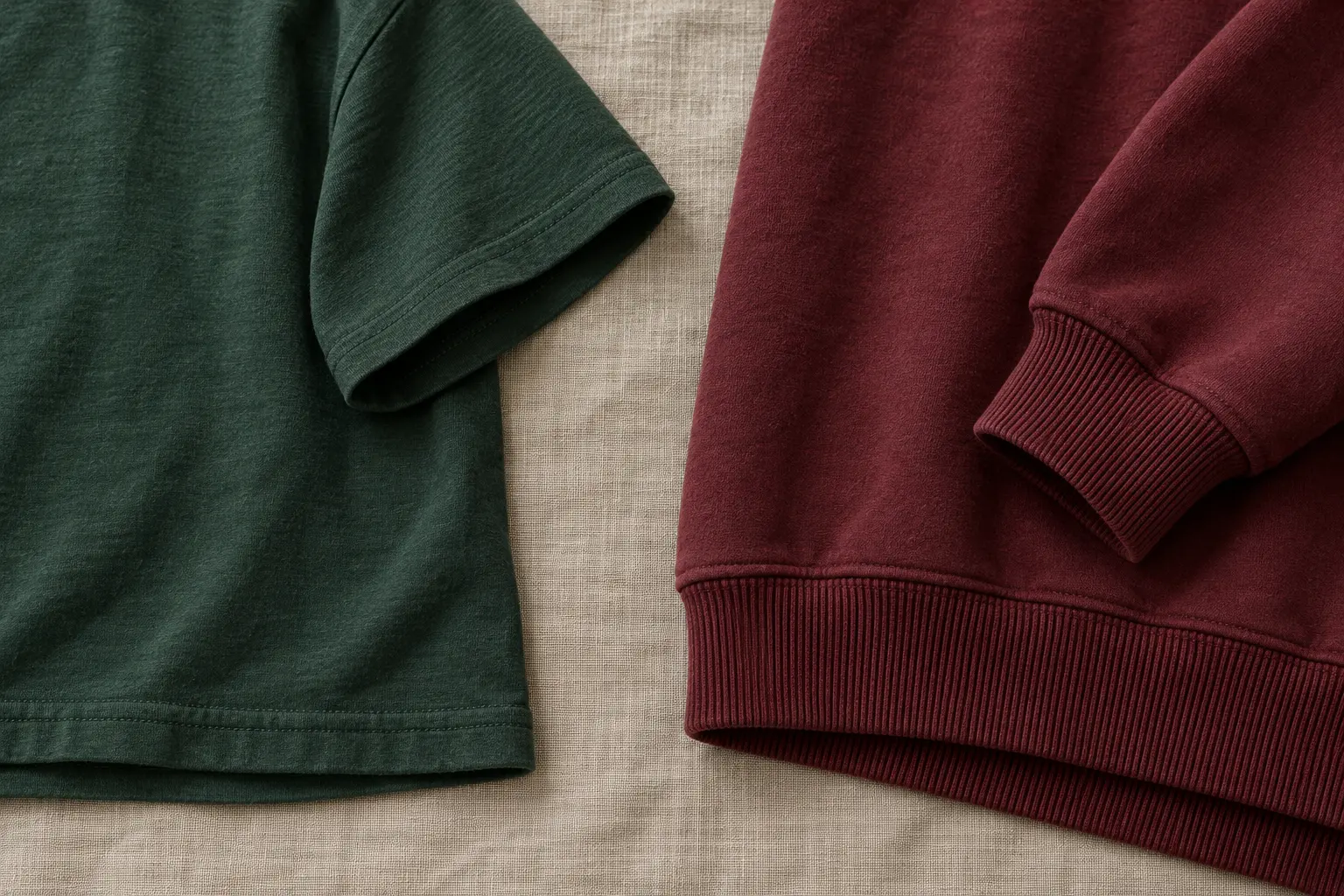
That bottom band is the big fit difference. A tee hem hangs open, so extra length just hangs lower. A ribbed band grips. On a sweatshirt that’s long for you, the band settles at the hip and the extra fabric blouses above it. On one that’s short, the band sits at the waist and there’s no fixing it.
| Feature | Heavyweight Unisex Crewneck T-shirt | Heavy Blend Unisex Crewneck Sweatshirt |
|---|---|---|
| Listed size range | S to 5XL | S to 3XL |
| Fabric | Heavyweight jersey knit; see the listing for fiber content by color | Fleece; manufacturer lists 8.0 oz/yd², 50/50 cotton-polyester in solids |
| Bottom edge | Open hem that hangs free | Rib band with spandex that grips |
| Sleeve end | Open short sleeve, can be rolled | Rib cuff, so sleeve length is fixed |
| What to match first | Chest width, then body length | Chest width with room for a layer, then sleeve length |
The practical rule: if you plan to wear the sweatshirt over a tee or a collared shirt you already own, fit it by chest width with a layer’s worth of room. For many people that’s simply their normal size, since the cut is already loose. Size up only if you want it slouchy or you’re between sizes.
For women, sizing down in the sweatshirt is less risky at the hip than in the tee, because the stretchy band has more give. It’s riskier in the sleeve. A smaller size shortens the sleeves, and a rib cuff makes short sleeves obvious.
Of the three sweatshirt designs, Save Some Breath is the one where the width choice is most forgiving. Its cyclist illustration, seen from behind with one foot on a kerb, sits with slab-serif lettering that crowds both ends of the composition while, per the catalog description, leaving empty grey margins at either side. Going roomy widens those margins and the print still looks centered and intentional. It’s listed in Graphite Heather, Maroon, Military Green and Carolina Blue, S through 3XL.
Hooded styles add another variable, since a hood adds weight at the back of the neck. The hoodie sizing and fit guide walks through that separately.
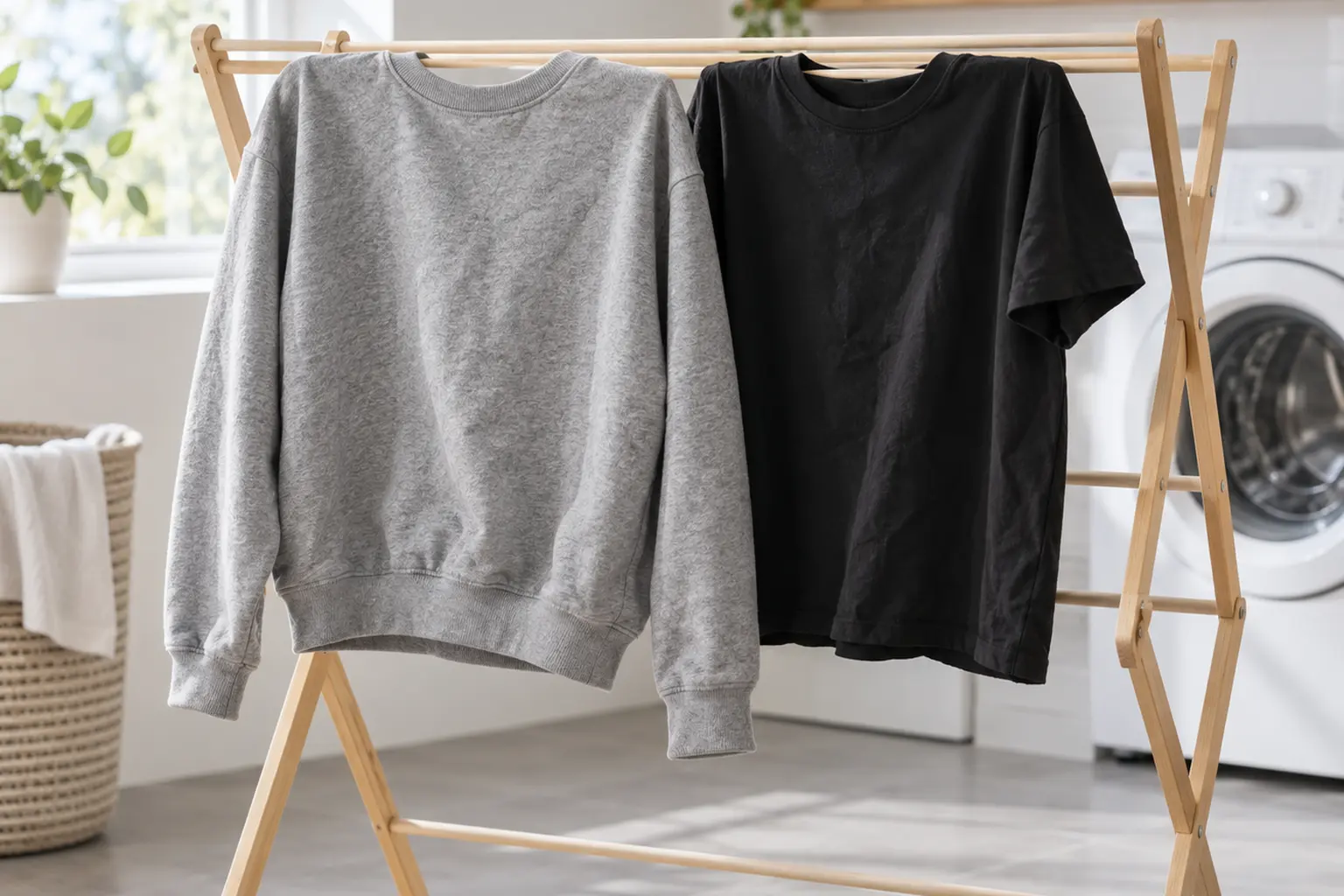
How Much Will It Shrink? Sizing for the First Wash
A shirt that fits out of the package and a shirt that fits after laundry day aren’t always the same shirt. Cotton is the reason. Cotton fibers swell in water and settle into a shorter, relaxed arrangement as they dry, while polyester takes up very little moisture and holds its dimensions under home-wash conditions [3].
The numbers, and what they apply to
Published test data on a 60/40 cotton-polyester single-jersey knit, washed warm and tumble dried on medium, puts first-wash shrinkage at 2–4% in length and 1–3% in width [3]. The same source gives 3–5% in length and 2–4% in width for brushed-back fleece in that blend [3]. For comparison, it cites 5–10% in length for a 100% cotton single jersey under the same conditions [3].
Those figures describe fabric categories, not these exact shirts, so treat them as a sense of scale. And scale is useful. On a hypothetical tee 29 inches long, 3% is a little under an inch. Five percent is closer to an inch and a half, which is the difference between covering your waistband and not.
Three more findings from that data shape the buying decision:
- It’s front-loaded. Roughly 70–85% of the total dimensional change happens in the first wash [3].
- The dryer matters more than the washer. Switching from high-heat tumble drying to line drying typically saves 1–2 percentage points of shrinkage at any wash temperature [3].
- Preshrunk doesn’t mean zero. The source describes pre-shrunk as a tolerance rather than a guarantee of no further shrinkage [3].
Turning that into a size decision
Length shrinks more than width, so the people most exposed are those already borderline on length: tall men, long-torso women, anyone sizing down. If you’re in that group and you tumble dry everything hot, choose the longer of your two candidate sizes. If you wash cold and dry on low or hang things up, buy the size that fits now.
As a judgment call, going up a full size purely as shrink insurance is usually overkill on a blended sweatshirt and sometimes reasonable on an all-cotton tee you intend to dry hot. Changing how you dry it is cheaper than wearing a shirt that’s too big for its first month.
As for instructions, federal rules require manufacturers and importers of textile clothing to provide regular care instructions at the time of sale, through care labels or other permitted methods [4]. So the garment’s own label is the authority on washing and drying, and it beats any general advice, including this.
How the Print Affects Fit: Placement, Scale and Feel
Sizing a blank tee is about your body. Sizing a graphic tee is also about a picture that has to sit somewhere on your body. Three things are worth thinking through.
Placement moves with the shirt
A front graphic is positioned relative to the collar. If the shirt is bigger than you need, the collar still sits at your neck, but the lower part of the design drops toward your stomach and the sides drift toward your arms. Sizing down pulls it all up and in.
The Accuracy Varies sweatshirt shows why this matters. Its two tall, pale blue words arc directly beneath the crew neckline, the illustration narrows into a bowling lane with three pins and a navy ball, and small team lettering runs along the bottom of the artwork. Wear it very oversized and that bottom line of type lands low on the torso, where a fold of fleece above the band can hide it.
Scale across the size run
In made-to-order printing, artwork is often produced at similar dimensions across sizes rather than enlarged in step with the garment. Where that’s the case, the same design looks bigger on a small and leaves more open fabric around it on a 4XL. Neither is wrong.
It does mean a dense, edge-filling composition looks densest in the smaller sizes. A design with deliberate breathing room tolerates extra surrounding fabric gracefully. The Snowy Forest Mice tee is one of those, with open pale cream snow in front of a gray-brown wall of trees and red lettering arched overhead. Check size-specific photos or mockups on the listing if they’re offered.
The feel of the printed area
Print method changes how a large graphic feels against you. Plastisol screen-printing ink bonds to itself as it cures rather than soaking into the fiber, and that surface deposit gives screen prints their characteristic weight and feel [6]. Direct-to-garment printing sprays water-based ink that bonds with cotton fibers, and dark garments need a white underbase pass before the color layer goes down [6].
Why should a shopper care? A printed panel generally doesn’t stretch as freely as bare knit. If you choose a size that’s snug across the chest, a large print is the part taking the strain, and that’s where you’ll notice stiffness. A size with normal ease lets the print rest flat. For big, heavily worked designs such as Cut Flowers Long Shadows, with its glass vase of six roses, thick red and black drop shadows and blackletter arches above and below, a relaxed fit is the more comfortable call.
If the listing doesn’t name the print method and the feel of the print matters to you, that’s a fair question to ask before ordering.
Between Sizes or Buying a Gift? A Decision Checklist
Sometimes you can’t measure anything. You’re buying for a dad three states away, or you’re honestly between two letters. Here’s how to break the tie without guessing blind.
If you’re between sizes
- Go up if you tumble dry hot, you’re long in the torso, you’ll layer under it, or the graphic is large and dense.
- Go down if you want a closer fit, you line dry, your hips are no wider than your chest, and the smaller size’s length still works on paper.
- Stay put if the only reason to change is that some other brand’s medium once ran small. Different blank, different inches.
If it’s a gift
The asymmetry is simple: a slightly big graphic tee gets worn, and a slightly small one goes in a drawer. When you’re torn between two sizes for someone, pick the larger. For a woman whose usual size you know, the same letter in unisex already supplies extra room, so there’s no need to add more.
Better than guessing, borrow a number. Ask a spouse or roommate to read the size tag on a tee the person wears constantly, or have them lay it flat and measure the chest. One pit-to-pit measurement is worth more than a paragraph describing someone’s build.
Sweatshirts are the safer gift garment when the size is uncertain. The loose cut and stretch band forgive an inch or two in either direction, and nobody complains that a crewneck is a bit roomy. Just remember the sweatshirts here are listed to 3XL while the tees go to 5XL, so for bigger recipients the tee may be the only option in the right size.
Because printed apparel is frequently produced after the order is placed, read the exchange terms on the product page before checkout, especially for a gift with a deadline.
Your next step
Pull your best-fitting tee out of the drawer and measure the chest and the length. Write the two numbers down. Then browse the graphic tees with those numbers in hand, and let the chart, not the letter, pick the size.
Frequently Asked Questions
Should women size down in a unisex graphic tee?
Only if you want a closer fit and the smaller size still clears your hips. Unisex tees are cut straight, so sizing down narrows the hem by the same amount as the chest. If your hips are wider than your bust, or you like a relaxed look, order your usual letter. Compare the chest width of a tee you already own to the product's garment measurements before deciding.
Do unisex shirts run big or small?
Compared with a women's-cut tee in the same letter, a unisex shirt generally runs bigger: wider shoulders, longer sleeves, a longer body and no waist shaping. Compared with a men's tee, it usually runs about the same, because unisex patterns are typically built on men's proportions. Size letters aren't tied to fixed inches, though, so one blank's medium can differ from another's. The garment measurements on the listing settle it.
How do I measure a T-shirt to find my unisex size?
Lay a tee you like flat and measure straight across from armpit seam to armpit seam for chest width. Then measure from the top of the shoulder at the collar down to the hem for length. Match the chest width to the size chart first and use length to break a tie between two sizes. Doubling the chest width gives you the shirt's full circumference, which is handy for checking against your hips or waist.
Will a heavyweight cotton tee shrink after washing?
Some shrinkage is normal in cotton knits, and most of it shows up in the first wash. Published test data on cotton-polyester jersey shows roughly 2–4% in length under warm wash and medium tumble drying, with all-cotton jersey cited as higher [3]. Dryer heat is the biggest factor you control, so drying on low or line drying keeps the fit closer to how it arrived. Follow the care label on the garment itself.
Should I buy the same size in a crewneck sweatshirt as in a tee?
Often yes, but check rather than assume. The Heavy Blend crewneck is described by its manufacturer as a classic fit for loose comfort, with rib cuffs and a bottom band [2]. That band grips instead of hanging free, so length and sleeve length matter more than they do on a tee. If you'll layer a shirt underneath or you're between sizes, the larger size is the safer pick.
What size should I order when buying a graphic tee as a gift?
If you can, get the size tag or a chest measurement from a tee the person already wears. If you can't and you're torn between two sizes, choose the larger, because a slightly roomy graphic tee still gets worn and a tight one doesn't. For women, the usual letter in unisex already gives a relaxed fit. Check the exchange terms on the product page before ordering, since printed items are often produced after you buy.