
 OBJECT
Most western and desert graphic tee outfit ideas fail the same way: the shirt tries to do all the work. A cactus, a cowboy hat, a sunset and a slogan all fight for the same chest, and suddenly you look dressed for a theme night instead of a long drive through dry country.
The better approach is quieter. Let the color of the shirt and the weight of the fabric set the desert mood, and choose a graphic about working land rather than a souvenir of it. In the StyleMZ lineup, the clearest example is the engraved cotton-field design “Your Next Favorite Shirt.” It comes on three different blanks, in sand, khaki, mocha, gold and green shades. Below you’ll find how to choose the color, the blank and the fit, followed by three outfits built around jeans and boots you already own.
What Makes a Graphic Tee Read Western Without Looking Like a Costume
Western style, in the everyday American sense, is less about cowboys than about materials and work: denim, leather, canvas and sun-faded color, all things that look like they have been used outdoors. A graphic tee belongs in that wardrobe when its art speaks the same language. Literal motifs can work, but they put a lot of weight on one image. The more symbols you stack, the closer you get to costume.
Three design qualities tend to read as western or desert-adjacent even when there isn’t a cactus in sight:
- Old print techniques. Engraving lines, cross-hatching and woodtype lettering recall feed-store signs, almanacs and old mail-order catalogs. They look made, not downloaded.
- Working subject matter. Fields, machinery, barns and harbors show people doing a job, which ties back to the workwear roots of western dress.
- A narrow, earthy palette. Cream, charcoal and one muted accent sit comfortably next to faded denim and brown leather.
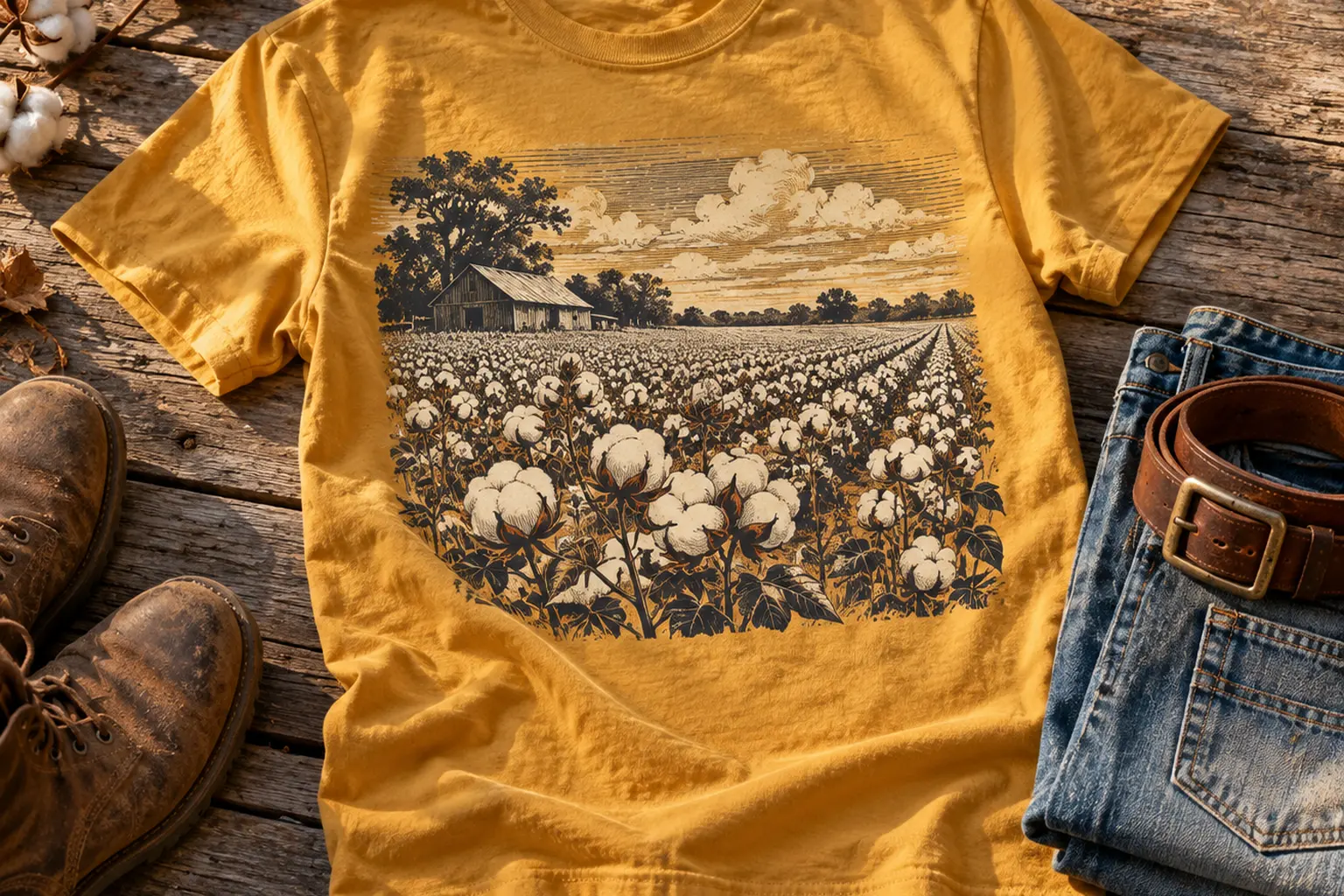
The “Your Next Favorite Shirt” artwork checks all three. A cotton picker rolls through white rows toward a small barn, oversized open bolls crowd the edges in fine engraving lines, and the lettering is chiseled and faceted like carved woodtype. The joke is that your next favorite shirt is still growing out in the field. It lands with anyone who knows where cotton comes from, and in plenty of farm country, that’s most people.
To be clear about scope: none of the designs covered here is a cactus, cowboy or mesa print. If that’s exactly what you want, this article won’t talk you out of it. If you want a shirt that sits naturally in a western wardrobe and still says something specific, a cotton-country graphic is the sharper pick. It’s about a place and a trade rather than a postcard of one.
The coastal designs in the same collection, “Salt Gets Into Everything” and “A Very Large Excuse,” share the engraved, workmanlike drawing style but point toward harbors and drawbridges. They belong to a different trip, and they come back up in the outfit section.
The Desert Palette: Picking a Tee Color That Works With Denim and Leather
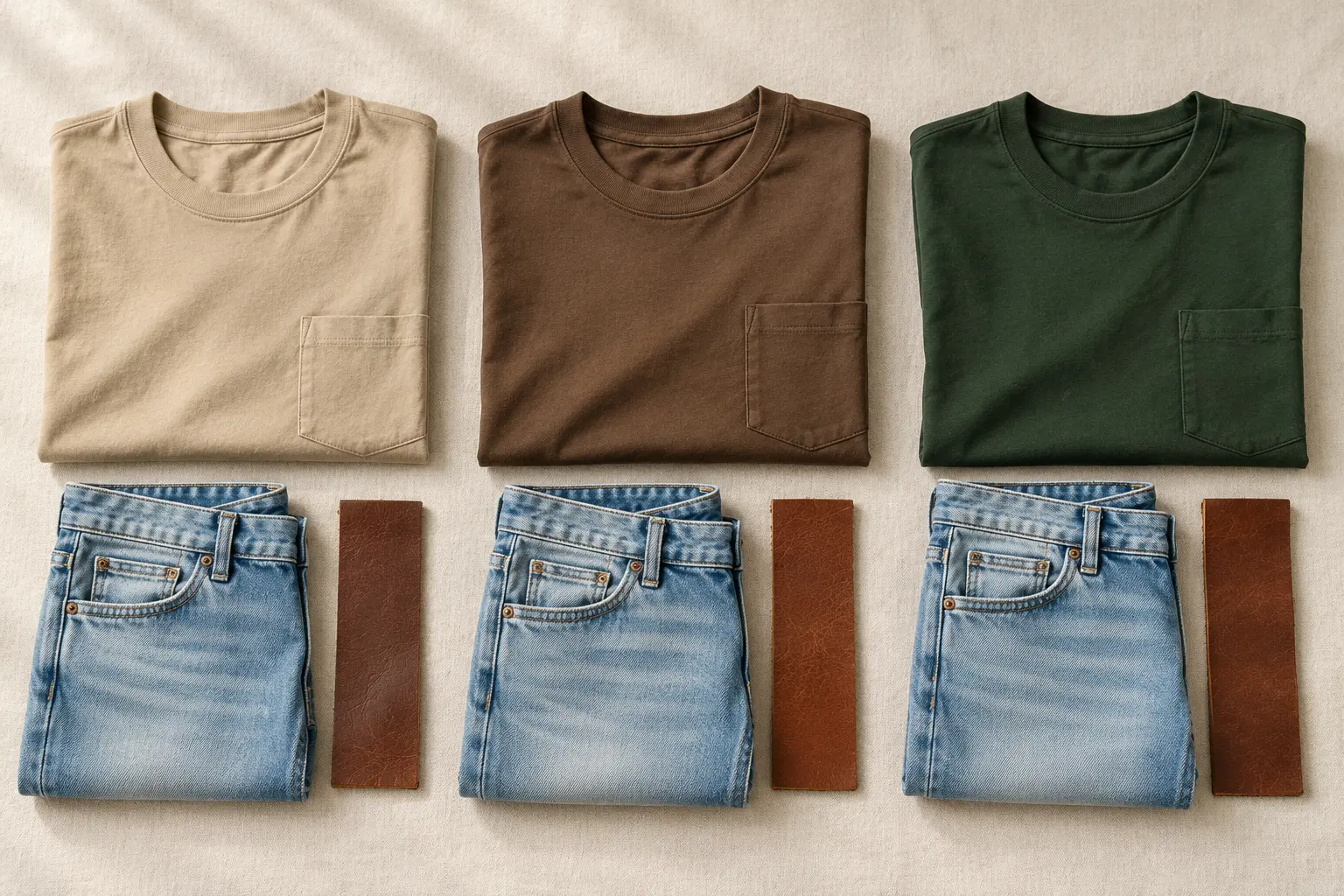
Color matters more in a western outfit than the graphic does, because it’s what people notice from across a parking lot. The desert palette comes from dust, dry grass, rust and shade: sand, khaki, cream, mocha, olive and muted gold. Aim for a tee that sits one step away from your denim and leather, not one that matches them.
Here’s how the relevant colorways sort out:
- Sand and khaki are the most literal desert tones. “Your Next Favorite Shirt” comes in Sand on the long sleeve and Khaki on the oversized tee. The long-sleeve “Salt Gets Into Everything” also comes in Sand.
- Mocha and cream are available on the oversized heavyweight version. Mocha works especially well with brown leather, and cream reads like unbleached canvas.
- Gold and Natural appear on the standard heavyweight crewneck. Gold is the bolder choice, close to late-summer dry grass. Natural is the safe neutral.
- Military Green and Forest Green cover sage-and-scrub territory and suit a wardrobe that already leans olive.
- Cardinal Red is a rust-adjacent accent and louder than the rest. Pair it with plain, darker denim so it’s the only bright thing in the outfit.
- Black works, but it pulls the look toward evening and town rather than the trail.
The one-step rule
Wear a sand tee with tan pants and you get one monochrome block that flattens the graphic. Wear the same tee with mid-wash blue jeans and brown boots, and each piece reads on its own. The same logic applies to mocha. Next to a brown leather belt it looks deliberate, but next to brown trousers it can turn muddy.
A simple way to apply this: if your favorite jeans are faded light blue, lean toward gold, mocha or green. If they’re a dark rinse, cream, Natural and sand give the most contrast.
Don’t forget the ink color
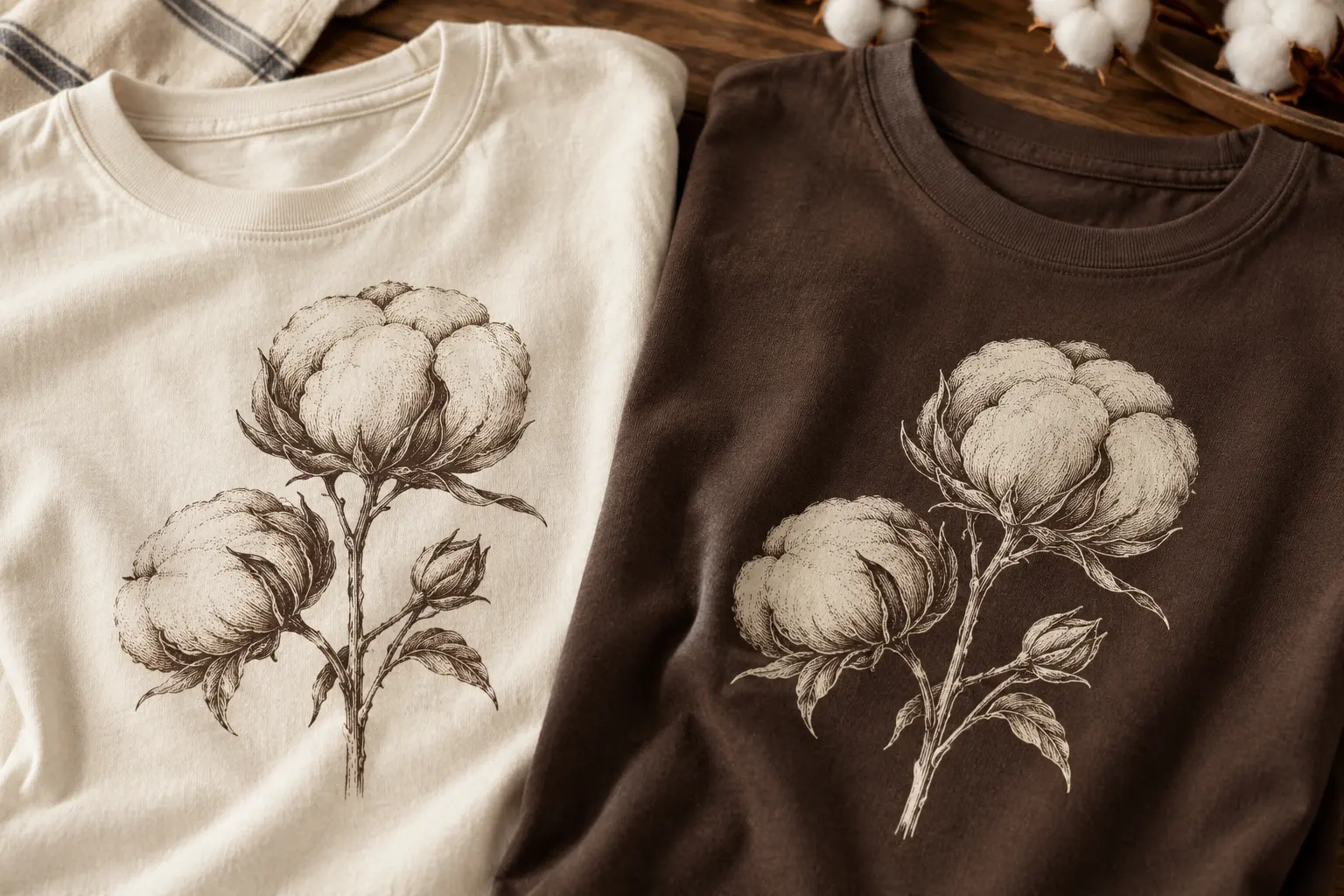
The catalog describes the cotton-field artwork as cream bolls with charcoal shading. On Natural or Cream, expect lower contrast, with the art reading quietly, like a worn feed sack. On Gold, Forest Green or Mocha, the cream ink stands out and the engraving lines become the main event. Neither is wrong. Decide whether you want the shirt noticed or just felt.
For most people building a first western-leaning outfit, the standard heavyweight crewneck in Gold or Natural is the easiest place to start. It covers the widest size range of the three versions, and both colors bridge blue denim and brown leather without much thought.
Western Graphic Tee Blanks Compared: Weight, Sleeves and Size Range
The same artwork comes on three garments, and the blank changes how the outfit behaves more than most shoppers expect. Fabric weight affects drape, how the shirt holds a print and how it layers. Sleeve length decides which season it belongs to. Size range decides whether it’s an option at all, which is the first thing gift buyers should check.
| Version | Blank | Listed weight and fiber | Sizes | Desert-friendly colors | Where it fits best |
|---|---|---|---|---|---|
| Heavyweight Unisex Crewneck | Gildan 5000, classic fit | Listed as heavyweight; confirm fiber by color on the product page | S–5XL | Gold, Natural, Forest Green | Everyday warm-weather wear; widest size range |
| Unisex Longsleeve | Gildan 2400, classic fit | 6.0 oz/yd²; solid colors 100% cotton | S–2XL | Sand, Military Green | Cool mornings, layering, fall gifting |
| Men’s Oversized Heavyweight | Shaka Wear SHMHSS, relaxed fit | 7.5 oz; 100% USA cotton in most colors | S–3XL | Khaki, Mocha, Cream | Untucked, workwear-heavy looks |
What the weight numbers mean
Gildan lists the 2400 long sleeve at 6.0 ounces per square yard [1]. Its solid colors are 100% U.S. cotton [1]. Sport Grey on that blank is 90% cotton and 10% polyester, while its heathers are a 50/50 cotton-poly blend [1]. The oversized version is listed in the catalog at 7.5 oz, with most colors in 100% USA cotton and the grey heathers in cotton blends.
As a general rule, heavier cotton hangs straighter and shows wrinkles less, which is why heavyweight tees look closer to workwear than a thin fashion tee does. The trade-off is heat. On a hot, still afternoon, more cotton is more fabric to warm up and dry out. That doesn’t rule out the oversized tee for desert trips, but it makes it a morning-and-evening shirt more than a midday-hike shirt.
Why fiber content matters for the graphic
Printful’s direct-to-garment guidance says 100% cotton gives the most opaque print result [7]. The same guidance notes that 90/10 heather colors print with a slightly vintage feel, and that true blends look more faded [7]. If you want the engraving lines to look crisp, stick with a solid color. If you like a broken-in look, a heather can be a feature rather than a flaw. None of the desert colorways above is a heather, though. The only heather in this group is Dark Heather on the coastal crewneck.
Size range is the quiet dealbreaker
Only the standard crewneck runs to 5XL. The oversized tee stops at 3XL and the long sleeve at 2XL. If you’re buying for a bigger dad or friend, that decides the blank before color ever comes up. It’s better to get the right garment in your second-choice color than the wrong garment in the perfect one.
Oversized or Classic Fit for a Ranch-Leaning Silhouette
A western outfit usually looks best when the tee is neither tight nor tent-like. You want enough room to move, a hem that lands around the belt or just below, and shoulders that don’t slump halfway to the elbow. That leaves room for both a classic and an oversized cut. The question is which matches how you actually wear your jeans.
A detail in the size charts worth knowing
Compare the laid-flat charts and something stands out. The oversized Shaka Wear version and the classic Gildan 5000 crewneck list identical chest and length measurements from S through 3XL. Both show an 18-inch chest at Small rising in 2-inch steps to 28 inches at 3XL. Both list lengths from 28 to 33 inches, with about an inch of tolerance either way.
So at the same tag size, “oversized” here does not mean a wider chest or a longer body on paper. The differences you can count on are the heavier listed fabric and the relaxed men’s cut. The chart doesn’t give sleeve or shoulder measurements for the oversized blank, so don’t assume a dropped shoulder you can’t verify. If you want a truly roomy, boxy look, the honest move is to size up by one and measure first. This is covered in more depth in the guide to choosing an oversized vs regular fit graphic tee.
How to decide
- If you tuck a tee into belted, higher-rise jeans, the classic crewneck in your usual size is the cleaner choice. Less fabric bunches at the waistband, and the buckle stays visible.
- If you wear tees untucked over straight-leg jeans, the oversized heavyweight gives a sturdier, more workwear look. Consider sizing up one if your current tees already fit close.
- If you’re between sizes, lay your best-fitting tee flat, measure pit to pit and from the high point of the shoulder to the hem, then match those numbers to the chart. That beats guessing from height and weight every time.
The unisex charts also mean women shopping for themselves should size by measurement rather than by their usual women’s size. The unisex graphic tee sizing guide walks through that conversion. For anyone who wants the heaviest fabric in the group and plans to wear it loose over denim, the oversized version in Khaki or Mocha is the most western-looking of the three.
Long Sleeves for Cool Desert Mornings and Easy Layering
Dry country is known for big swings between a chilly early morning and a hot afternoon, so a single short-sleeve tee doesn’t always cover the day. A long-sleeve graphic tee handles the cold end of that range. It also works as a base layer under an overshirt you already own, which is about as western as a layering system gets.
The long-sleeve “Your Next Favorite Shirt” is on the Gildan 2400. Gildan lists that blank with a classic fit and describes it as a heavyweight tee suited to layering or wearing on its own [1]. The construction details matter for outdoor wear. Gildan specifies taped neck and shoulders for comfort and durability [1]. The cuffs are ribbed with spandex for stretch and recovery [1]. In practice, that’s the feature that lets you push the sleeves to the forearm when the afternoon warms up and pull them back down later without the cuffs going slack.
Three ways to layer it
- Under an open flannel or denim overshirt. With the overshirt unbuttoned, the center of the artwork shows, and the big chiseled “Favorite Shirt” lettering reads clearly. The small arched “Your Next” sits above it. This is the most useful layering setup for a cold morning that turns into a mild afternoon.
- Under a vest you already own. A canvas or quilted vest keeps your core warm and leaves the sleeves and much of the graphic visible.
- Alone, with sleeves pushed up. On mild days it’s a complete outfit with jeans and boots, and it looks a little more pulled together than a short-sleeve tee.
Check the sleeve, not just the chest
The catalog chart lists sleeve lengths from 32.5 inches at Small to 38.5 inches at 2XL. Long-armed people should compare those numbers to a long-sleeve shirt that already fits, because a too-short sleeve is the first thing that makes a long-sleeve tee look borrowed. Remember that this blank tops out at 2XL.
For desert colors, Sand is the obvious pick, and Military Green is the one that hides trail dust best. If you’re browsing other options in the same format, the long sleeve shirts collection is the place to compare designs. For a gift landing in fall or early spring, this version tends to get more wear than the short sleeve.
Three Western and Desert Outfit Formulas to Copy
Formulas beat inspiration boards because you can repeat them. Each of these assumes clothes most people already have: blue jeans, a leather belt, boots or sturdy shoes, and maybe an overshirt. The tee is the only new piece.
Situation one: a gift for a dad who farms cotton
The catalog pitches this design to exactly that person, and the joke works best on someone who has watched a picker work real rows. Suppose he wears work jeans and boots most days and a cap he’s had for years. Get him the standard heavyweight crewneck in Gold or Forest Green in his usual size, so it slots into what he already wears without asking him to change anything. If Father’s Day is close and he runs cold in the mornings, the long sleeve in Sand is the better pick. Check that he’s within S–2XL first.
Situation two: a Southwest road trip
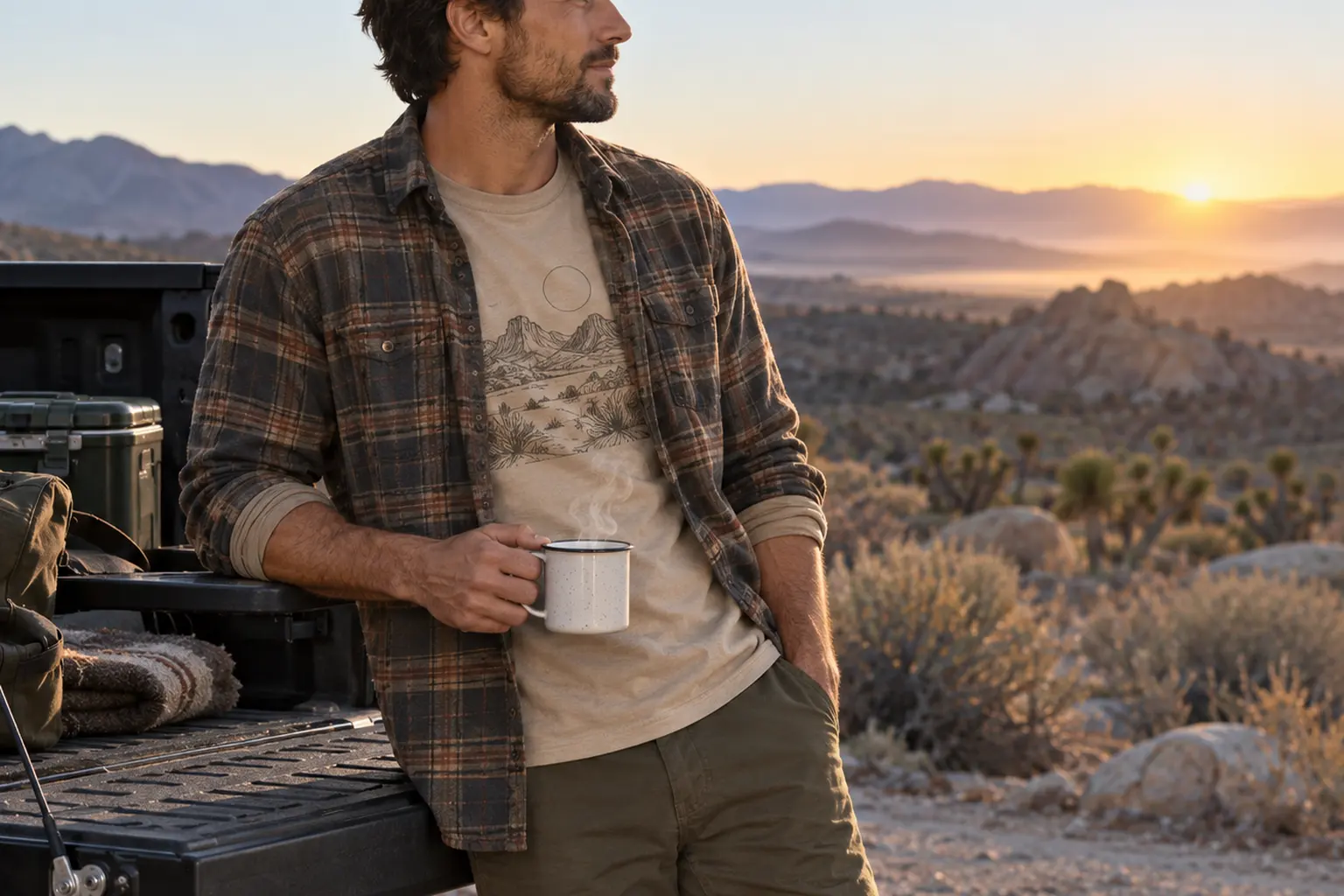
Say you’re driving for a week through hot afternoons, cool mornings and a few nights in town. Pack two tees, not one. Wear the oversized heavyweight in Khaki or Cream with straight-leg jeans and boots for mornings, evenings and diner stops, when the heavier cotton feels right. Keep the long sleeve in Sand for early starts under an open overshirt. Leave the black version at home. In a sunny parking lot it gets warm fast, and it reads more like a city night out than a canyon overlook.
Situation three: a weekend in town that still says western
Here the look should be cleaner. Wear the oversized tee in Black or Mocha with dark-rinse jeans, a plain leather belt and clean boots. Keep everything else solid and simple. The engraved art and woodtype lettering supply the rural character, so you don’t need a statement buckle or a patterned shirt on top.
When the trip is coastal, not desert
Not every outdoorsy getaway involves sand of the desert kind. For a harbor town or a lake with a drawbridge, the coastal designs fit the setting better. “Salt Gets Into Everything” shows a salt-crusted denim shirt drying on a clothesline in front of a lighthouse, and the long sleeve comes in Sand and Military Green, so it still pairs with the same jeans and boots. “A Very Large Excuse,” with its ship squeezing through a drawbridge, is the gift for the coworker who blames the bridge every morning.
A common mistake runs through all three situations: adding a second loud piece. Pair a graphic tee with a patterned overshirt and a big buckle, and the three start arguing. Keep one talking piece per outfit.
Print and Fabric Details That Decide How the Shirt Ages
Part of the western appeal is a shirt that looks better broken in than new. How a graphic ages depends on the fabric, the garment color and the decoration method. The product pages don’t name a print method, so it’s worth knowing how the common methods behave and which choices you can control.
What the common methods do
Direct-to-garment printing sprays water-based ink into the fibers of a cotton garment rather than laying it on top [5]. On white or light 100% cotton, that produces a very soft hand [5]. Dark garments are harder for DTG, because they need a pretreatment spray and a white underbase that can leave a faint halo if the work is sloppy [5]. Direct-to-film transfers sit on top of the fabric as a thin film and feel slightly thicker than a DTG print [5]. Printful also notes that ribbed areas are printed unstretched, so the print can open up and show gaps when the rib stretches [7]. That’s one reason chest graphics live on the flat body panel and not on cuffs or collars.
What that means for your color choice
- Light, solid colors such as Natural, Cream, Sand and Light Blue are the friendliest conditions for a soft print on cotton. Expect lower contrast with cream ink.
- Dark solids such as Black, Forest Green and Mocha make the cream engraving stand out more, but they need an underbase to do it. Look at the print edges when the shirt arrives.
- Heathers and blends give a faded, vintage look by design, as covered earlier. That’s a plus if you want instant patina.
If you’re curious why some new tees look decades old on day one, the piece on what makes a graphic tee look vintage breaks down how art, ink and fabric each contribute.
Care, briefly
Follow the care label for each garment. It’s the authority, and directions can differ between blanks and colors. One small trap: Gildan lists a tear-away label on the 2400 [1]. If you remove it for comfort, note the fiber content and care directions on the product page or the inside label before you tear it out. Beyond that, a heavyweight cotton tee is built for ordinary wear. Think of it as a work shirt, not a museum piece.
Who This Western Graphic Tee Look Suits, and Who Should Skip It
A design-led, earth-tone approach to western dressing isn’t for everyone, and that’s fine. Here’s a quick sort.
Good fit
- People who already wear denim, boots and leather and want a tee that fits in rather than takes over.
- Gift buyers shopping for someone with a real connection to cotton farming, or anyone who enjoys a quiet joke about where clothes come from.
- Road-trippers and outdoor people who want something that looks right at a gas station, a trailhead parking lot and a small-town diner.
Probably skip
- Anyone who specifically wants cactus, cowboy, horse or mesa imagery. These designs suggest the West through mood and materials, not literal symbols.
- Shoppers who need a size above what a given blank offers: 2XL for the long sleeve and 3XL for the oversized tee. Look at the standard crewneck instead, which goes to 5XL.
- People who want a lightweight tee for midday heat. All three versions are sold as heavyweight.
Once you’ve settled on the look, make your decisions in this order: size range first, then sleeve length for the season, then color by your jeans, and fit last, using measurements. If you’re still weighing a hat against a tee for a modest gift budget, the guide to gifts under $40, embroidered hats or tees makes that call by the recipient’s size, which is the right place to start.
Frequently Asked Questions
What do you wear with a western graphic tee?
Mid-wash or dark-rinse blue jeans, a leather belt and boots or sturdy leather shoes are the core. Choose a tee color one step off from your denim and leather, such as gold, sand or mocha with blue jeans and brown boots, so each piece reads on its own. Add an open flannel or denim overshirt on cool days. Keep it to one statement piece, and let the graphic be that piece.
Are heavyweight tees too hot for desert weather?
They can be at midday. More cotton means more fabric to warm up and dry out. Heavyweight tees shine in mornings, evenings and shoulder seasons, and they hold their shape and hide wrinkles better than thin tees. On a desert trip, wear the heavyweight for travel and town, and plan something lighter for long, hot hikes.
Should I size up in an oversized graphic tee?
Check the chart before deciding. For the oversized "Your Next Favorite Shirt," the listed chest and length measurements match the classic Gildan 5000 crewneck at each size from S to 3XL. The difference is the heavier fabric and relaxed cut, not bigger numbers. If you want a noticeably roomier, boxier look, measure a tee you own and consider going up one size.
Will the graphic look faded on light-colored shirts?
It will look lower-contrast rather than faded. The cotton-field artwork uses cream and charcoal, so on Natural or Cream the cream elements blend in and the charcoal engraving carries the image. On darker colors like Gold, Forest Green or Mocha, the cream stands out. Heather and blend fabrics are the ones that print with an intentionally faded, vintage look.
Is a cotton-field graphic tee a good Father's Day gift?
It's an especially good one for a dad who farms cotton or grew up around it, because the joke depends on knowing where shirts begin. Confirm his size against the blank's range first: the standard crewneck runs S to 5XL, the oversized tee S to 3XL and the long sleeve S to 2XL. Choose the long sleeve if he runs cold or the gift will mostly be worn in fall.