
 OBJECT
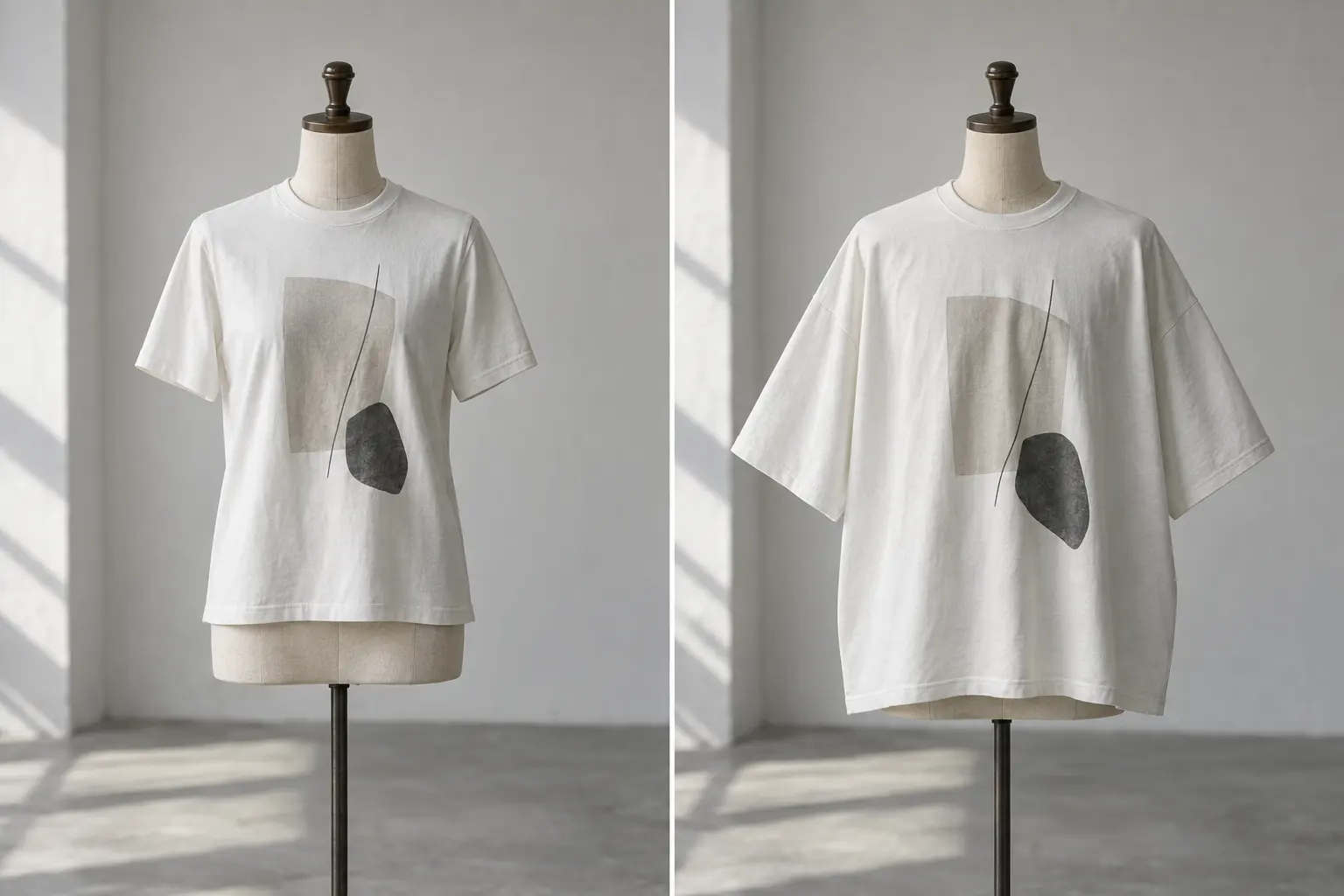
The oversized vs regular fit graphic tee decision usually starts with a tempting shortcut: order one size larger and expect the silhouette in your reference image. But what you want may be more width, not more length—and a larger letter on the label does not explain that difference.
Start with the proportions of a tee you already enjoy wearing. Choose additional volume only when the chest, hem and sleeves move toward the shape you want. For StyleMZ originals, select the artwork on its own merits, then establish the fit through measurements. The featured crewnecks are not documented here as dedicated oversized patterns, so none should be treated as a guaranteed boxy cut.
Oversized vs regular fit graphic tee: the difference is proportion
Regular and oversized are useful descriptions, but they are not interchangeable with small and large. A manufacturing fit reference defines regular proportions through moderate chest and shoulder ease, while oversized proportions combine greater chest width, a more extended shoulder and fuller sleeves [5]. The important distinction is coordination: the silhouette comes from several dimensions working together.
Boxy means something more specific. It describes a wide body relative to a comparatively short length, whereas an oversized shirt may have either a controlled or a long body [5]. If your reference is broad and compact, asking only for a larger size misses the feature that makes it appealing.
Separate the shape you want from the label you recognize
Use the following comparison as a vocabulary tool, not a promise about any featured product. These fit distinctions follow the manufacturing reference’s definitions [5]. Your task is to identify which relationship you want before selecting a size.
| Fit direction | Defining relationship | Choose it when | Main compromise |
|---|---|---|---|
| Regular | Moderate room with conventional body and sleeve proportions | You want a contained outline | It may not deliver the volume in an oversized reference |
| Relaxed | More room while keeping familiar overall proportions | You want extra space without a dramatic silhouette | More room does not necessarily mean boxy |
| Oversized | Greater chest width, shoulder extension and sleeve volume | You want volume to lead the outfit | Length and sleeve reach need equal attention |
| Boxy | Greater width relative to body length | You want a broad, compact outline | A larger regular size may not reproduce it |
The practical rule is straightforward: if you like your current tee’s hem position but want a wider body, do not accept extra length as an unavoidable substitute for width. Seek a measurement combination that preserves the length you like. If the available sizes cannot do that, the particular shirt may not provide your intended silhouette.
Nor should you choose regular proportions merely because you think a particular body type is supposed to wear them. Treat fit as a preference about space, coverage and outline. A broad shoulder, a fuller midsection or a shorter torso is a reason to compare the relevant measurements—not a reason to abandon the graphic you like.
For a more focused companion to this distinction, the unisex crewneck fit guide helps frame the decision around silhouette. Keep the objective concrete: familiar, roomier, longer or wider-and-shorter. Those descriptions are more actionable than simply wanting a tee to look oversized.
Measure a favorite tee before choosing your graphic tee size
Your most useful reference is not the size you usually buy. It is a shirt whose actual proportions you understand. Choose one you wear comfortably in the way you intend to wear the new graphic tee: untucked, tucked or beneath an open layer. A reference you already dislike cannot tell you much about a successful fit.
Finished-garment measurements and body measurements describe different things and should not be substituted for each other [5]. A chart describing the wearer’s chest is therefore not directly comparable with a flat measurement across a shirt. Establish what the chart measures before interpreting its numbers.
Record the dimensions that control the outline
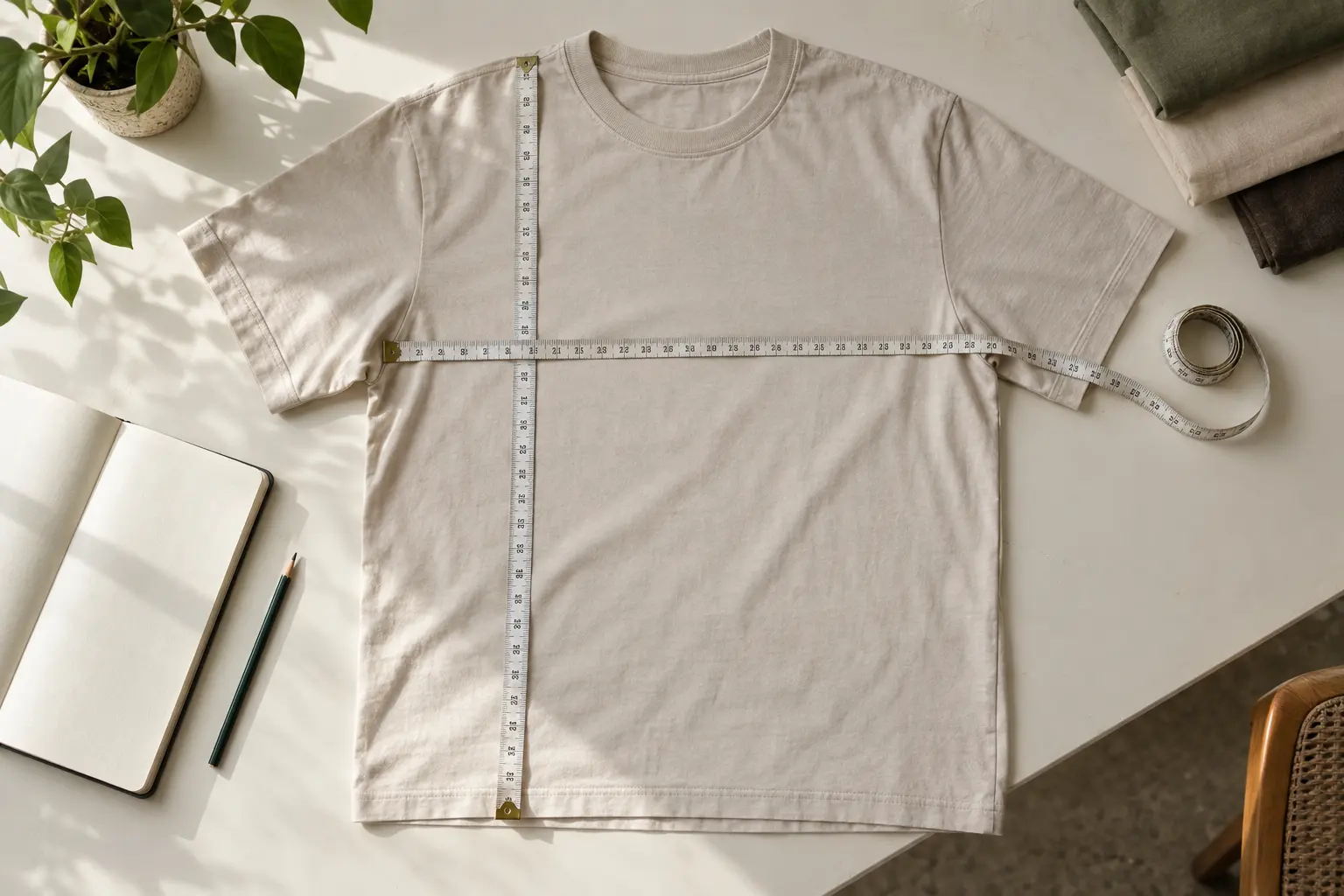
Manufacturing measurement methods commonly include flat half-chest, shoulder width, body length from the high point of the shoulder, and sleeve length from the shoulder seam; the specified start and end points matter [5]. For your comparison, use the product chart’s method wherever it supplies one. Do not quietly mix a center-back length with a shoulder-to-hem length.
- Choose the reference. Lay your preferred tee flat and arrange it without deliberately stretching it wider or longer.
- Record chest width. Follow the chart’s stated location and note that the result is a flat width, not a full circumference.
- Record body length. Use the same starting point shown in the chart and identify where that hem sits when you wear it.
- Add shoulder and sleeve measurements. These help explain why two similarly wide shirts can produce different upper-body outlines.
- Compare the proposed size as a group. Highlight every dimension that changes, rather than approving the size because its chest measurement looks promising.
A simple hypothetical calculation makes the distinction clear. Suppose your reference measures 22 inches across the chest and a candidate measures 24 inches using the same method. That is two additional inches of flat width, or approximately four around the garment. These are illustrative numbers, not measurements for any StyleMZ product.
Now examine what happens to length. If that same candidate adds more body length than you want, it has not solved your particular problem. You wanted width with a controlled hem; you found width accompanied by another change. Keep both observations in the decision instead of allowing the chest number to overrule everything else.
Also read sleeve length together with shoulder extension. When a shoulder seam moves outward, it adds reach before the sleeve itself begins [5]. A sleeve measurement that looks familiar in isolation can therefore finish farther down the arm on a different block. This is one reason a full measurement comparison is more useful than a universal instruction to go up one size.
Graphic scale: choose the artwork separately from the fit
A graphic tee has two compositions: the illustration itself and the illustration within the garment. Your buying decision needs to account for both. The artwork may be densely layered or deliberately open; your preferred silhouette may be narrow, roomy or compact. Neither choice automatically determines the other.
Consider the proportion mathematically. If a printed image stays the same width while the shirt becomes wider, the image occupies a smaller share of the shirt’s width. That does not establish how any particular StyleMZ print is sized across its range. It simply explains why buying a larger garment is not, by itself, a way to obtain a larger-looking graphic.
A controlled choice for layered gaming artwork
The “Controller Ribbon Graphic” Heavyweight Unisex Crewneck T-shirt combines a worn gray-white controller with cream ribbon banners, red and blue lettering, a small crown and pale stars. Its Korean wording expresses the feeling that playing games is something you cannot quite resist. The controller’s d-pad, buttons and paired joysticks remain distinct within deliberately scratched and speckled artwork.
Choose this design if you want recognizable objects and a readable visual hierarchy rather than an uninterrupted field of marks. The ribbons organize the message around the controller, while the surrounding gray field leaves space between the outer details. Natural, White, Light Pink and Sand are the listed garment colors, with sizes S through 5XL.
My editorial preference here is to begin with your familiar garment proportions and change them only for a clear styling reason. The artwork already supplies multiple visual layers; you do not need extra garment volume to give it interest. If you prefer a broad silhouette, however, that remains a valid choice—just do not expect sizing up to enlarge the controller or lettering.
Intentional distressing deserves a separate reading. The scratches, dot speckling and torn-looking ribbon edges belong to this illustration’s design. Choose it because you like that visual language, rather than expecting a pristine controller icon. Conversely, the illustrated wear is not information about the shirt’s future wash performance.
- Want the artwork to lead? Start with a silhouette that feels familiar and keep the rest of your outfit visually quiet.
- Want the silhouette to lead? Prioritize the chest-to-length relationship before deciding how much surrounding fabric you prefer.
- Need a particular print scale? Seek size-specific print dimensions rather than treating a mockup as a measurement.
This separation makes the purchase more precise. You can love the graphic and still decide that an available size does not produce the shape you want. That is a fit decision, not a judgment against the design.
Regular or roomy: three outfit situations that change the answer
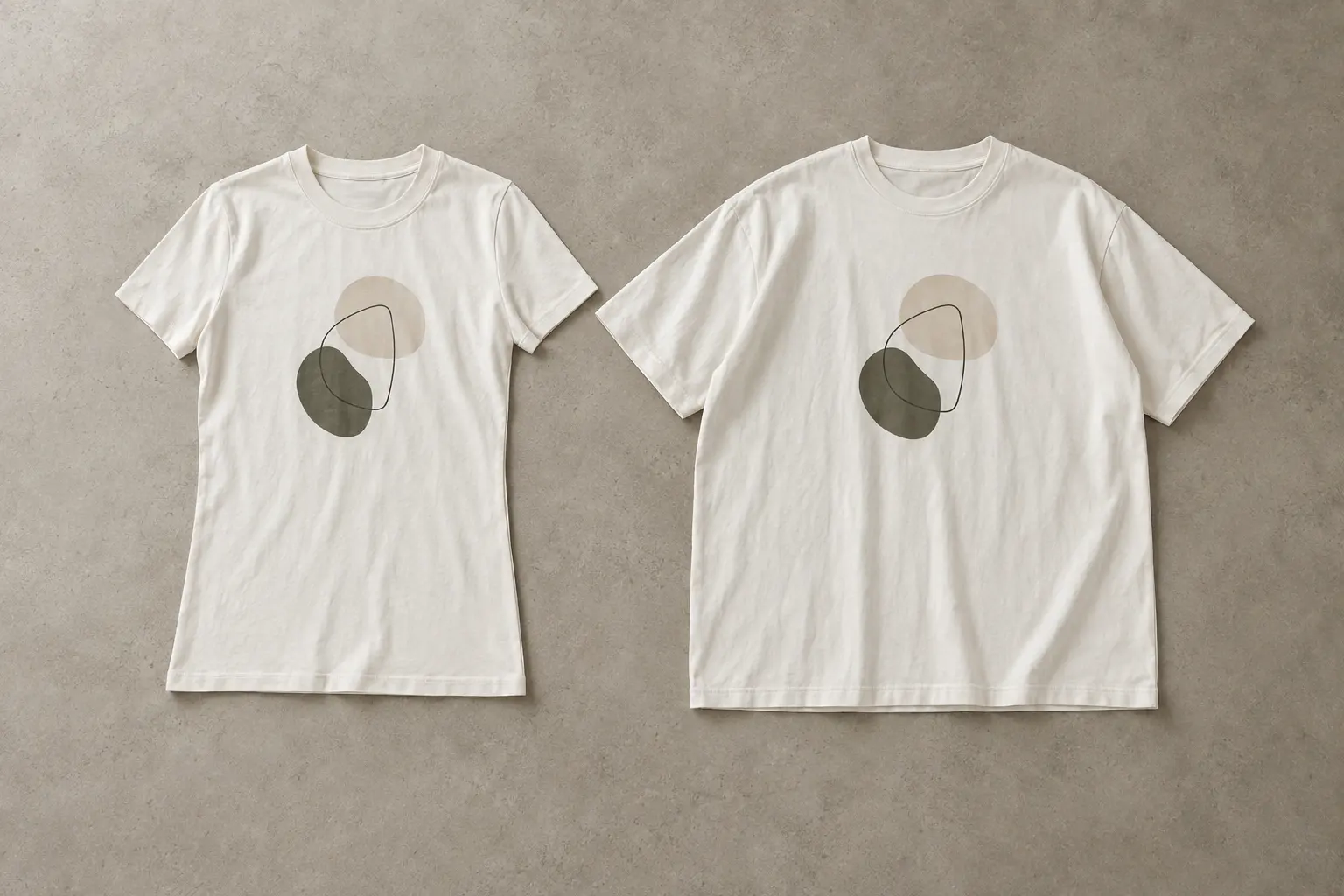
Fit advice becomes useful when it meets an actual outfit. Instead of asking which silhouette is more fashionable, decide what you want the tee to do with clothes you already own. A shirt intended to sit beneath another layer has a different job from one intended to define the whole outline.
If you want a contained tee beneath an open layer
Suppose you already own an overshirt or jacket and want a graphic visible through the opening. Start with the tee whose existing proportions you know work beneath that piece. Compare the candidate against it rather than choosing additional volume as an abstract improvement. Try the reference with the layer both open and closed so you can judge your preferred amount of fabric.
Give print visibility its own decision. Do you want the central motif visible, or the entire composition? Those are different styling aims, especially with graphics containing small peripheral marks. The graphic tee layering guide offers a useful next step if the outer layer, rather than the tee alone, is driving the purchase.
If you want the tee to be the outfit’s main volume
Imagine wearing the shirt untucked with straight trousers you already own. Here, a roomier silhouette may be the point rather than a side effect. Establish the hem position you prefer, then choose width within that boundary. Letting every measurement grow without a clear limit is not the same as making a proportion choice.
The “Bulldog Beef Graphic” Heavyweight Unisex Crewneck T-shirt suits a deliberately busy visual direction. Pale Cook capitals dominate the upper composition; beneath them, a forward-facing bulldog wears a black shirt marked with orange Beef lettering. A double-decker bus, telephone box, steaks and orange marks build a crowded surrounding scene.
This is the option to consider when you want the graphic itself to supply most of the outfit’s visual activity. Forest Green, Black, Navy and Maroon are listed, with sizes S through 5XL. A roomier size can be a styling choice if its measurements work for you, but the crowded artwork is not evidence of an oversized garment pattern.
If extra length is usually your problem
Suppose tees already finish lower than you prefer, yet you still want more space through the body. Do not make sizing up your default. Set a maximum acceptable length using your reference shirt, then assess the available widths within it. If none works, keeping your familiar fit—or declining this particular silhouette—is more sensible than buying something you already expect to alter.
These situations lead to different answers without requiring different rules. Choose dimensions for the outfit’s job. The graphic can be bold in a contained silhouette or intricate in a roomy one; the useful question is whether each choice was intentional.
Heavyweight graphic tees: what fabric can and cannot tell you
The featured short-sleeve product names describe heavyweight unisex crewnecks. That is useful shopping language, but it does not supply an exact fabric weight, stiffness or finished silhouette. Treat the description as a starting point rather than a shortcut to claims about opacity, softness or how the hem will hang.
Pattern and fabric work together. The manufacturing reference explains that a firmer, higher-weight jersey can hold a more structured outline, while a lighter or softer jersey can fall downward so that similar dimensions appear narrower and longer [5]. This is a category-level mechanism, not a verified feel assessment of these particular printed shirts.
Weight is a clue, not a fit guarantee
GSM means grams per square meter: a measure of fabric mass per area, rather than the total weight of the finished shirt. The same manufacturing reference cautions that weight alone cannot predict drape or quality because stretch, stiffness and knit structure also matter [5]. For buying purposes, do not translate heavyweight directly into boxy.
Likewise, do not assign fiber percentages from a color name. A listing such as Graphite Heather or Ash Heather identifies a color option here, not a complete composition statement. If fiber content matters to your choice, use the composition for that exact variant. A general blank-family description is not enough to settle a color-specific question.
This distinction also matters for decoration. Retrieved DTG production guidance reports that its process generally produces more opaque results on 100% cotton, while blends can allow more fabric to show through the print [6]. That is an explanation of one printing workflow; it does not establish the process or finish used for every featured StyleMZ item.
- For silhouette: prioritize finished measurements, then look for evidence about the actual fabric’s structure.
- For fiber preferences: use the selected color’s composition rather than inferring it from the garment name.
- For print expectations: distinguish the artwork’s intended distressing from any documented characteristics of its decoration method.
Price does not resolve these questions either. A more expensive graphic is not automatically a differently engineered blank, and a weight descriptor does not establish construction quality. The discussion of what actually matters in a premium tee is a useful companion when you want to separate design value from garment specifications.
Keep the judgment narrow: choose the illustration because it appeals to you, the dimensions because they suit you, and the material because its documented characteristics meet your needs. No single adjective should make all three decisions.
Made-to-order graphic tees are not made-to-measure garments
Print-on-demand describes a production approach, not a fit category. It should not be read as a promise that a shirt’s shoulder, length or sleeve proportions will be customized for your body. Unless a product explicitly offers a different service, choose from its stated garment options rather than assuming the printing stage changes the underlying pattern.
The same distinction applies to the decoration technique. DTG, or direct-to-garment printing, applies ink directly to fabric, while DTF uses a transfer stage [8]. A made-to-order description alone does not tell you which process produced a particular graphic.
Why the method matters without deciding the fit
Retrieved production guidance positions DTG as useful for colorful, detailed, small-batch work on cotton-based garments, while screen printing gains an economic advantage for larger identical runs [8]. That helps explain why digital printing belongs in a discussion of original, made-to-order graphics. It does not prove which method StyleMZ uses for an individual item.
Dark-garment DTG workflows also involve pretreatment and a white ink underbase to support the printed image [8]. Consequently, garment color is more than a styling decision within that particular process. Still, you should not infer a specific shirt’s print thickness, softness or durability from the color alone.
File preparation is another independent variable. DTG guidance explains that enlarging a file without adding image information reduces its dots per inch, and it identifies flat surfaces as easier to print than areas interrupted by construction details [6]. Neither problem can be solved by the shopper choosing a larger size. Garment fit and image preparation are different parts of the product.
- Fit question: which available garment dimensions match your intended silhouette?
- Artwork question: do you like the design, its intentional marks and its relationship to the garment?
- Production question: what technique, print dimensions and fulfillment information are actually stated?
Do not let a technology label stand in for proof of performance. None of the featured descriptions establishes a tested wash-life figure for its decoration. Equally, a single screen image cannot settle exact printed color; the retrieved DTG file guidance explicitly warns that the physical print will not exactly match the screen [6].
The sensible expectation is specific rather than pessimistic: judge the design confidently, assess fit through dimensions, and reserve performance conclusions for documented information about the finished product.
Graphic long-sleeve shirts need a second fit decision
If you want more coverage, switching to a long-sleeve graphic shirt is a different decision from enlarging a short-sleeve tee. You are choosing another garment format. Begin the comparison again rather than assuming that the same size letter will reproduce the same silhouette.
The “Feline Lightning Graphic” Unisex Longsleeve T-shirt offers a visibly different design direction. A half-lidded pink cat sits above stacked bubble lettering, with jagged blue bursts, barcode details and scattered small symbols around the central composition. Its Korean wording means today’s drop. The listed garment colors are Sport Grey Heather, Ash Heather and Military Green, with sizes S through 2XL.
Choose it for the illustration and coverage, not an oversized promise
This design suits you if you prefer a character-led graphic with a graffiti-style arrangement rather than the controller artwork’s ribbon structure. The pink face provides a clear point of attention within the surrounding marks. Select the long-sleeve format because you want that coverage; the illustration’s streetwear language does not establish a dropped-shoulder pattern.
For fit, bring a long-sleeve reference into the comparison. Shoulder extension adds reach before the sleeve begins, so sleeve length and shoulder width need to be considered together [5]. Looking only at the cuff-to-seam measurement can miss the relationship that determines where the sleeve finishes on you.
- Keep the body comparison: chest width and hem position still determine your preferred outline.
- Add total sleeve reach: assess shoulder and sleeve measurements as a pair.
- Use the correct size range: this featured long-sleeve option ends at 2XL, rather than the 5XL listed for the two featured short-sleeve crewnecks.
If you prefer the gaming illustration, the supplied “Controller Ribbon Graphic” Unisex Longsleeve T-shirt is another relevant format, also listed in S through 2XL. Its available colors differ from the short-sleeve version. Treat that as a separate product choice, not simply the same purchase with extra fabric attached.
For outfit planning, decide whether the sleeves will remain visible or sit beneath something you already own. That answer gives the coverage a purpose and keeps you from using sleeve length as an indirect substitute for the wider body you actually wanted.
Before buying: settle the measurements, then the care expectations
Your final decision should be a short comparison, not another search for the perfect fit adjective. Write down the dimensions you want to preserve and the ones you want to change. Then compare the exact garment, size and color against that brief. This turns a vague wish for oversized styling into a purchase you can explain.
Resolve the missing information once
If the listing does not provide enough information, ask one focused set of questions before ordering. Request the finished chest width and body length for your candidate size, the measurement method, and shoulder or sleeve measurements where they affect your choice. Add color-specific composition, print dimensions or decoration details only when those would change the decision.
- Preserve: the reference shirt’s successful hem position, coverage or neckline balance.
- Change: the specific amount of room or visual volume you actually want.
- Confirm: the selected variant, relevant measurements and any stated production timing.
- Separate: fit expectations from artwork preferences and print-performance expectations.
Care belongs in this final assessment, but it should remain product-specific. Follow the finished garment’s care label and any decoration instructions supplied with it. The available product details do not justify assigning all these shirts a particular wash temperature, drying method or shrinkage percentage.
Do not buy an oversized shirt intending to shrink it into the correct proportions, or a tight shirt expecting wear to produce a controlled boxy outline. Neither plan gives you a documented route to the measurements you want. Choose a size whose intended starting dimensions make sense rather than relying on an unverified transformation afterward.
For a gift, the same reasoning favors concrete information over a guessed label. Ask for measurements from a tee the recipient already likes, with their permission, or establish their preferred silhouette before choosing the design. The Korean graphic tee gift guide can help with the artwork side of that decision.
Your next step is small: measure one successful shirt. If a candidate preserves its useful proportions while adding the volume you want, proceed. If it offers only a larger label and more uncertainty, keep looking within the available options rather than forcing the fit.
Shop the collection: Korean graphic tees, Korean long sleeve shirts, Korean sweatshirts, Korean hoodies and Korean tank tops – original graphics designed in Korea, made to order.
Frequently Asked Questions
Should I size up one size for an oversized graphic tee?
Not automatically. An oversized pattern coordinates chest width, shoulder extension and sleeve volume, whereas grading a regular pattern upward can also change length and neckline proportions [5]. Compare the proposed size with a shirt you already like. Size up only if the combined changes suit the silhouette you want.
Is a boxy T-shirt the same as an oversized T-shirt?
No. Boxy describes width relative to a comparatively short body, while oversized describes a deliberately enlarged silhouette that may be long or controlled in length [5]. A shirt can be both, but one term does not guarantee the other. If you want a compact outline, body length deserves as much attention as chest width.
Will the graphic get bigger if I order a larger tee?
Do not assume it will. The supplied product details do not establish how print dimensions change across sizes. Ask for size-specific print information if the artwork's scale is central to your decision. Choose garment size for fit rather than using it as an indirect print-size selector.
Are the featured StyleMZ crewneck tees guaranteed oversized?
No dedicated oversized pattern is established in the supplied details. The featured short-sleeve options are described as heavyweight unisex crewnecks, which does not specify a boxy width-to-length ratio. Choose the "Controller Ribbon Graphic" or "Bulldog Beef Graphic" for its documented artwork and available variants. Determine the silhouette separately through finished measurements.
Does heavyweight cotton guarantee a better graphic print?
No single weight descriptor guarantees the finished print result. Retrieved DTG guidance identifies fabric composition as a variable and also notes that very thick cotton can absorb ink in a way that makes the image appear more faded [6]. The actual process and its execution matter alongside the fabric. For these products, do not infer a particular print finish from heavyweight alone.
Can I use the same size for a short-sleeve and long-sleeve graphic shirt?
Use the same letter only if the relevant measurements support it. Long-sleeve fit requires attention to shoulder width and sleeve reach as well as chest and body length. The featured "Feline Lightning Graphic" long-sleeve shirt is listed in S through 2XL, so its range also differs from the featured short-sleeve crewnecks. Compare each product separately rather than treating size letters as interchangeable.