
 OBJECT
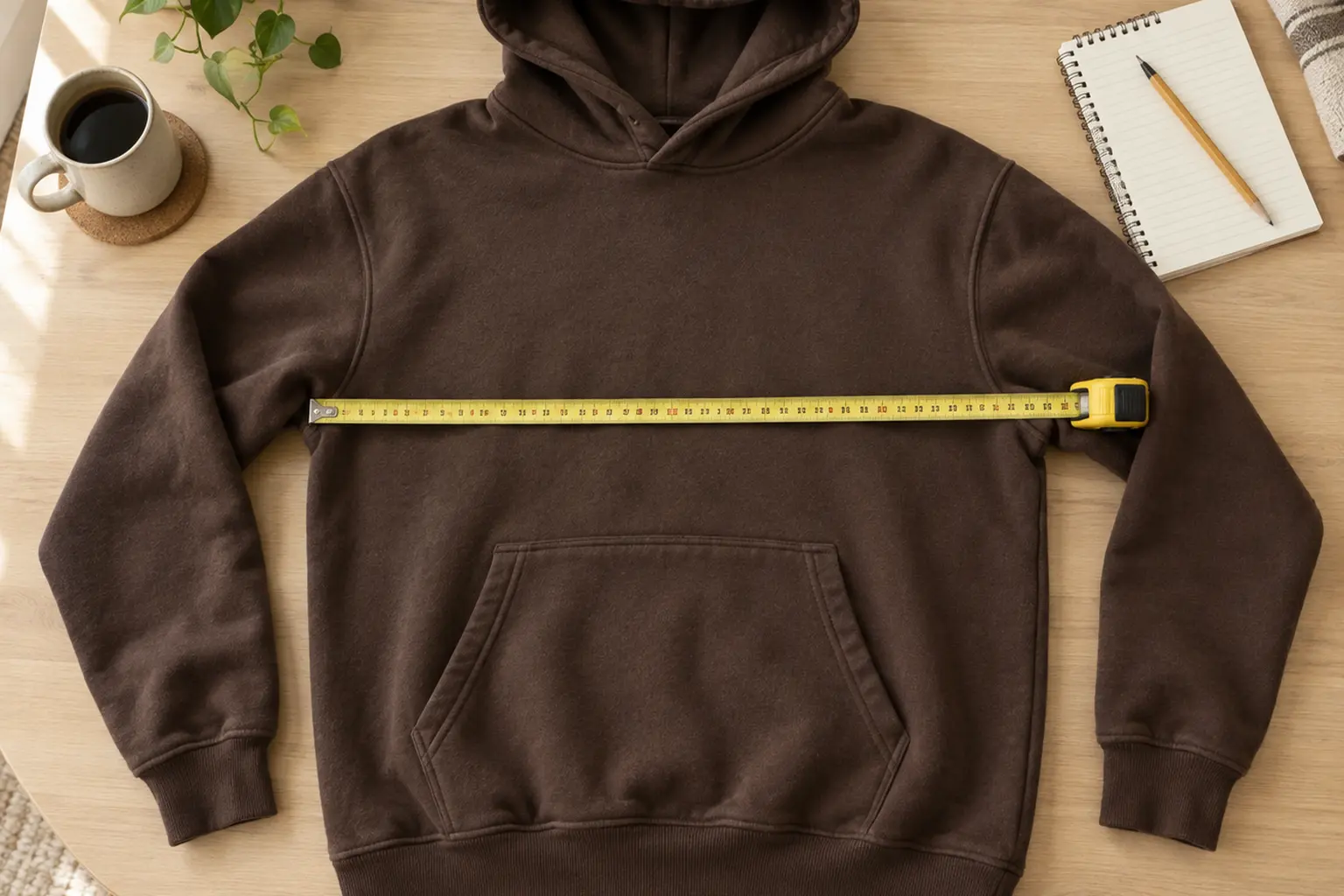
A graphic hoodie sizing and fit guide should settle one question: your usual size, or one up? Here is the answer most people need. Order your usual size unless one of three things is true: you plan to wear something thick underneath, you dry everything on high heat, or you have a long torso. If any of those apply, go up one.
That rule works because heavy-blend pullovers are cut roomy to begin with, and because the letter on the tag tells you far less than two numbers on a size chart. The rest of this piece shows how to read those numbers, how to measure a hoodie you already own, and what happens to the artwork on the front when you change sizes. Ten minutes with a tape measure beats a return label.
Usual Size or One Up? The Rule That Covers Most Buyers
Start from the size you normally buy in a relaxed sweatshirt. Then look for a reason to move.
The reasoning comes from how this kind of garment is cut. A screen-print shop that publishes measurements for one widely used heavy-blend pullover describes it as a fleece-weight, slightly boxy garment with a generous chest and a body length that is proportional but not elongated [6]. The same shop reports that the blank generally runs true to size for adults of average build [6]. In other words, the room is already built in. You do not need to buy it.
All six hoodies discussed here are listed as Heavy Blend Unisex Pullover Hoodies in S, M, L, XL, 2XL and 3XL. That published chart is a useful picture of the category, not a promise about any single listing, so treat the size chart on the product page as the final word and use the numbers below to understand what you are looking at.
The three reasons to go up one
- A thick layer underneath. A T-shirt takes up almost no room. A flannel or a second sweatshirt does.
- A hot dryer. If laundry in your house gets one setting and it is the high one, plan for the hoodie to end up a little smaller than it arrived.
- A long torso. Chest fit and length fit are separate problems, and length is the one people forget.
The one reason to go down
If everything you own is slim or athletic cut and you want this to fit the same way, the usual size will feel loose. Dropping one size tightens the chest, but it also shortens the body, so check length before you commit.
A word on “unisex.” It means one pattern graded across the size run, not separate men’s and women’s cuts. There is no waist shaping and no adjustment at the shoulder, so shoppers who usually buy women’s sizing should lean on the measurements and skip the mental letter conversion.
How to Read a Graphic Hoodie Sizing and Fit Guide: Flat Width Is Not Your Chest
Most size charts for pullover hoodies list two things: body width and body length. Both describe the garment, not the person wearing it. This is where most wrong orders begin.
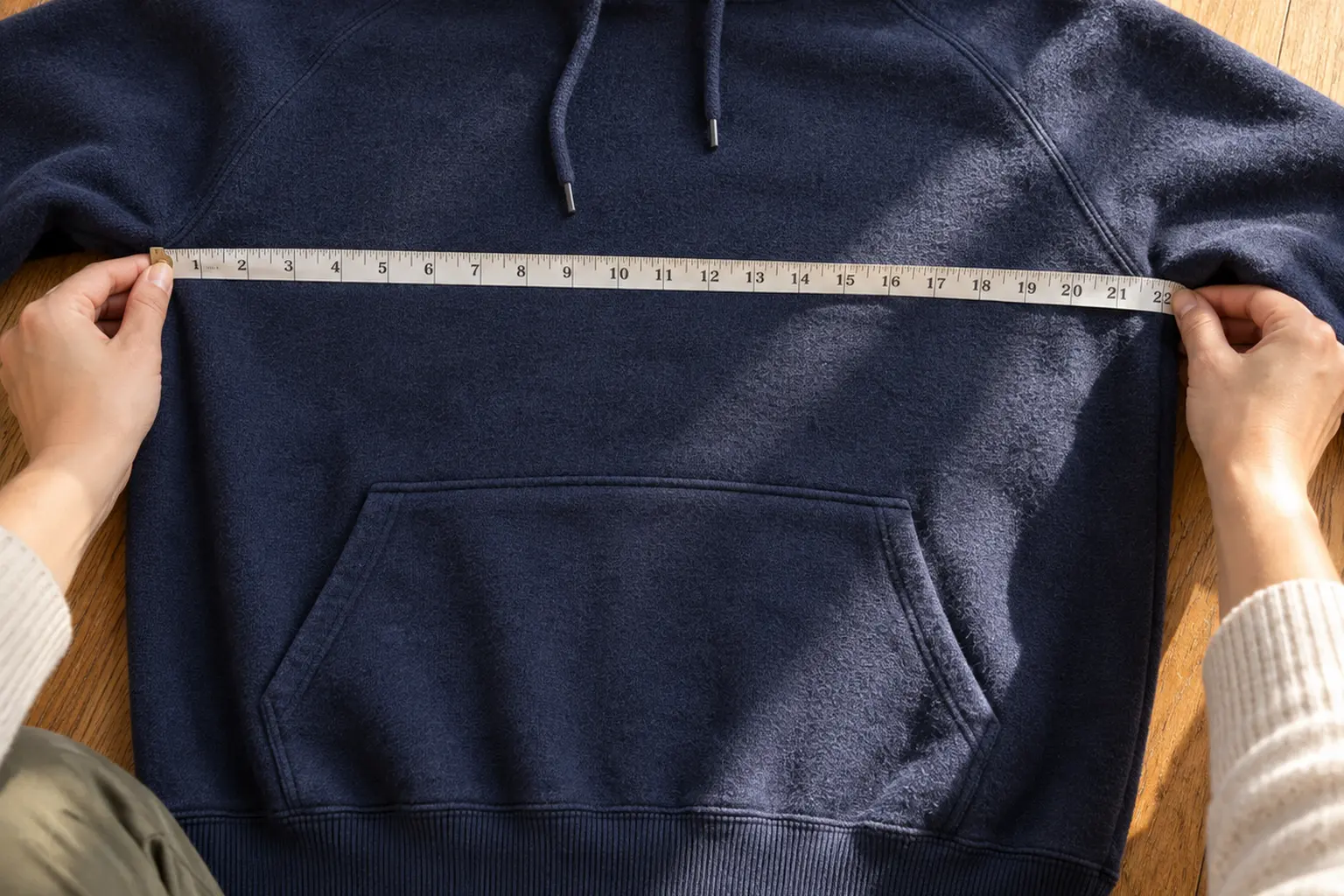
In the published chart for that reference blank, width is measured across the chest one inch below the armhole with the hoodie laid flat, and you double the figure to get the full chest circumference [6]. A medium listed at 22 inches wide is therefore 44 inches around [6]. If you read 22 and think “my chest is 40, that’s way too small,” you have compared half a hoodie to all of you.
Ease: the number nobody prints
Ease is the gap between your body and the garment. It is what lets you raise your arms, sit down, and fit a shirt underneath. Fleece needs more of it than a T-shirt does, because the fabric itself is thick and takes up space on the inside.
The same source gives a worked example: a 40-inch chest in that 44-inch medium leaves about four inches of ease, which it calls standard for a relaxed fleece hoodie [6]. So the practical way to use any chart is this. Measure your chest, add roughly four inches for a relaxed fit, halve the result, and look for that flat width. Less ease reads trimmer. More reads slouchy.
What one size step actually buys you
Here are the reference measurements for that blank, small through 3XL [6]:
- S: 20 inches wide, 27 inches long
- M: 22 inches wide, 28 inches long
- L: 24 inches wide, 29 inches long
- XL: 26 inches wide, 30 inches long
- 2XL: 28 inches wide, 31 inches long
- 3XL: 30 inches wide, 32 inches long
Look at the pattern. Each step up adds two inches of flat width, which is four inches around your body, and only one inch of length. That lopsided trade is the most useful thing a chart can teach you. Sizing up is a very effective way to get more room in the chest and a fairly weak way to get more length. If the hem is your only complaint, going up a size hands you four extra inches of circumference to solve a one-inch problem.
The source also notes that a body length of 28 to 29 inches lands near the hip on most adults [6]. That gives you a quick sanity check for where the hem will sit before you measure anything.
How to Measure a Hoodie You Already Own in Five Minutes
The most reliable sizing tool is already in your closet. Pick the hoodie or sweatshirt whose fit you like best and measure it. You are no longer guessing how a number will feel, because you have been wearing the number.
- Lay it face up on a hard, flat surface. A bed lets the fabric sink and stretch; a table or floor does not.
- Smooth it without pulling. Fleece stretches easily under your hands, and a hoodie tugged flat can measure wider than it wears.
- Measure straight across the chest, about one inch below where the sleeves meet the body, edge to edge. Write it down.
- Measure from the highest point of the shoulder, beside the neck, straight down to the bottom of the hem. Write that down too.
- Compare both numbers to the chart on the product page. Match width first, then confirm the length is close.
Those two reference points are not arbitrary. The published chart above was taken flat across the chest and from the top of the shoulder to the bottom hem [6]. Measure the same way and your numbers will line up with it.
If you would rather measure yourself
Wrap a soft tape around the fullest part of your chest, keep it parallel to the floor, and hold it snug without squeezing [6]. Then add ease as described earlier. Body measurements are a fine backup, but a garment you already like has your fit preference built in, and that preference is the part a chart can’t know.
Mistakes that throw the numbers off
- Measuring the ribbed hem. The band at the bottom is narrower than the body by design. Measure the chest, not the waistband.
- Comparing across fabric weights. A thin, drapey hoodie and a thick fleece one can share a flat width and still fit differently, because the thicker one has less room inside.
- Skipping length. The print shop behind that reference chart calls this a common mistake that leaves taller people with hoodies that fit the chest and sit too short [6].
- Trusting the tag from a different label. Letter sizes do not transfer reliably from one maker to another. Inches do.
One limit worth knowing: charts of this kind usually stop at width and length. If sleeve length is your recurring problem, see whether the listing gives it. If it doesn’t, assume the sleeves grow along with the body when you size up, and decide whether cuffs past your knuckles are a price you will pay for a longer hem.
Size Up, Stay Put, or Size Down? Hoodie Fit by Situation
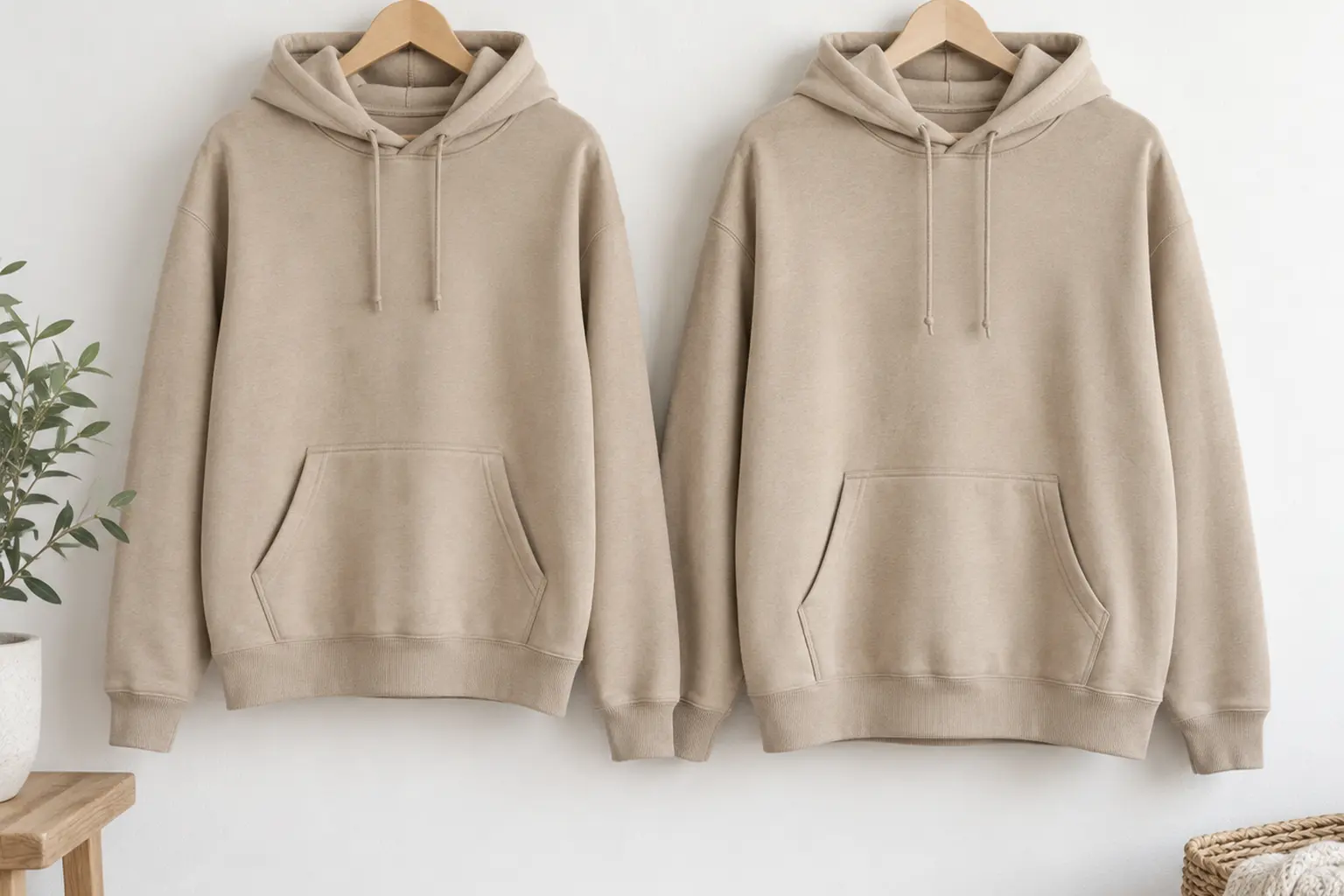
Now put the measurements to work. The right move depends on what goes under the hoodie, how you launder it, and how you are built. The table uses the reference chart’s steps of two inches in flat width and one inch in length per size.
| Your situation | Size move | Why it works | Trade-off |
|---|---|---|---|
| Average build, T-shirt underneath | Usual size | A boxy cut already carries relaxed ease | None, if the chart matches your favorite hoodie |
| Flannel, thermal or second sweatshirt underneath | One up | About four more inches around clears the extra layer | Sleeves and hem get longer too |
| Long torso, hem sits high | One up, after checking length | Adds about an inch of body length | You also take on four inches of width |
| Used to slim or athletic cuts | One down | Removes about four inches of circumference | Loses an inch of length, and leaves no margin for shrinkage |
| Hot wash and hot dryer, between sizes | The larger of the two | Leaves room for the first-wash settle | Roomier until it has been through the laundry |
Three hypothetical buyers show how this plays out.
If you stand on cold sidelines every Saturday and wear a flannel or thermal under everything, go up one. The print shop’s own advice for that blank is to size up by one when layering over something thick, so the hoodie has room without pulling at the shoulders [6]. If your layering runs the other way, with the hoodie over a tee and under a jacket you already own, the usual size is the better call, because bulk in the sleeves is what makes a jacket bind. There is more on that order of operations in this piece on how to layer a graphic tee for fall.
If you are tall and narrow, do the length check first. When your usual size comes up an inch short, going up one fixes the hem and leaves you with a wider body. Some people like that. If you don’t, stay in your usual size and protect the length you have by keeping it out of a hot dryer.
If you want a deliberately oversized look, one size up is usually enough on a cut that is already boxy. Two sizes up adds eight inches around by that chart’s math, which stops looking relaxed and starts looking borrowed. The same shape-versus-size logic applies to T-shirts, and it is laid out in this comparison of oversized and regular fit graphic tees.
The “Beneath the Overpass” hoodie is a natural pick for the layering crowd. The artwork frames a skateboarder under a rain-soaked Portland overpass, with large cream block lettering, rust-red depth and a slim banner reading “RAIN STAYS OUTSIDE,” and it comes in Dark Heather, Garnet, Navy and Dark Chocolate. It is a design about dressing for wet weather, so decide before you order whether it will be your outer layer or your middle one, and size accordingly.
Do Heavy-Blend Hoodies Shrink? What the First Wash Does to Fit
Yes, a little, and mostly early. How much depends on what the hoodie is made of and how hot you run the laundry.
Start with the label. Federal law requires most textile products to carry a label listing fiber content, country of origin and the business responsible for the product [4]. Under the Care Labeling Rule, manufacturers and importers must also provide cleaning instructions [4]. Those lines on the tag are the facts for your specific hoodie, and they outrank anything general you read here or anywhere else.
What a cotton-polyester blend typically does
The reference blank used throughout this article is 50 percent cotton and 50 percent polyester [6]. According to the print shop that documents it, that blend resists shrinkage better than an all-cotton hoodie but still loses some size in the first one or two washes if it goes through a hot wash and dryer cycle [6]. Most people, the shop says, see it settle about half a size smaller before it stabilizes [6].
The mechanism is worth a few sentences. Knit fabric is held under tension while it is made and finished, and water, agitation and heat let the loops relax back toward their resting shape. Cotton fibers swell when wet and do most of that moving, while polyester absorbs very little water and helps hold the fabric’s dimensions. That is why a blend moves less than pure cotton, and why the change is front-loaded.
Turning “half a size” into inches
If a full size is two inches of flat width on the reference chart, half a size is about one inch flat, or two inches around. Length shrinks as well. Since each size carries only one extra inch of length to begin with, a long-torso buyer feels it first.
This gives you two honest options:
- Change the laundry. The same source recommends cold water and a low tumble as the simplest way to preserve both the fit and the printed design [6]. If you will do that, buy the size that fits out of the bag.
- Change the size. If the hoodie will be washed and dried hot no matter what you intend, and you are between sizes, take the larger one.
What you should not do is buy snug and hope. A hoodie that is right at the edge on day one has nowhere to go but smaller.
What Sizing Up Does to the Graphic on the Front
A blank hoodie only has to fit. A graphic hoodie also has to frame a picture, and the frame changes when the size does.
The point to understand is that artwork and garment do not necessarily scale together. A 3XL has ten more inches of flat width than a small on the reference chart [6]. A print is not guaranteed to grow by the same proportion, and where it doesn’t, the same graphic sits on a bigger field of fabric with more blank space around it. Product photos are typically shown on one size, so if print scale matters to you, look for a stated print dimension or a mockup in your size. Don’t assume the photo is what you’ll get.
Why the fabric limits how a hoodie can be printed
Print method follows fiber and color. Dye sublimation, a process commonly used for all-over prints, works only on 100 percent polyester, high-polyester blends or polyester-coated hard goods [8]. It is also limited to white or very light products, because the process has no white ink and the dye cannot lighten the base color [8]. So cream lettering on a Dark Chocolate or Navy hoodie is not sublimated. It is laid down by a different process, as a placed graphic with a defined print area, not as color running seam to seam.
That matters for fit in a practical way. The design occupies a fixed zone on the chest, and everything outside it is plain fabric whose proportions shift with size.
Which designs are more forgiving
- Contained shapes such as a circular badge read as a deliberate emblem at almost any size, because extra margin just looks like breathing room.
- Type with built-in margin behaves the same way. The space around it is part of the design.
- Dense scenes depend on being read up close. On a much larger garment, fine detail takes up a smaller share of what the eye sees.
The “An Apology Cannot Choose Its Answer” hoodie is the clearest example of the second type. Its dark grey, elongated serif lettering is left-aligned and fills much of the upper half of the front, with a wide, quiet margin at the sides and bottom. The top line is distressed with small white flecks and uneven edges, while the line beneath is smoother. Because open space is already doing half the work, going up a size for comfort will not unbalance it. It comes in White, Light Pink, Ash Heather and Sand, which makes it the only hoodie here offered entirely in light colors.
One fit detail specific to roomy cuts: extra width gathers under the arms and at the sides when you move. A wide graphic on an oversized hoodie will fold along with that fabric. If you want the artwork to stay flat and readable, that is an argument for your usual size over a size up.
Choosing a Hoodie Size for a Gift When You Can't Ask
Gift sizing is the hard version of this problem, because the one measurement you need belongs to somebody else. Asking for a size spoils the surprise. Guessing spoils the gift.
Here is the order to try things in:
- Measure something they already wear. If you live with the person or can get near their closet, lay their favorite hoodie flat and take width and length. This is by far the best information available.
- Read a tag, with caution. The print shop cited throughout points out that people guess their size from whichever brand they wear most, and those sizes don’t always translate directly [6]. A tag tells you the neighborhood, not the address.
- Ask sideways. A partner, a sibling or a coworker who has shared a team order with them often knows.
- When truly stuck between two sizes, take the larger. A hoodie that is a little roomy looks like a choice. One that is a little tight looks like a mistake, and it gets worse after the first hot dry.
Returns deserve a look before you order, not after. The same shop notes that custom printed apparel can’t be returned the same way a blank garment can [6]. Policies differ from store to store, so read the return and exchange terms on the site, and leave enough time before the occasion for a size swap if one is allowed.
Matching the design to the person
Size is half of a gift. The other half is whether they would wear the picture. For someone who walks the shoreline with binoculars, or who simply likes quiet outdoor emblems more than loud slogans, the “WALK THE EXPOSED SHORE” hoodie is an easy one to give. A textured heron stands among rocky islets inside a circular badge, drawn in layered navy linework with muted gray and warm tan-orange areas, small pines and ferns along the shore, and a navy ribbon at the bottom carrying the Ebb Shore Field Society name. It comes in Dark Chocolate, Navy, Forest Green, Garnet and Sand.
A badge design like that is also the safer pick when you are unsure of size, for the reason covered above: a contained emblem tolerates extra fabric around it. More wildlife and pet artwork lives in the Animals & Pets collection if herons are not their bird.
The Last Fit Check Before You Order
By now the decision should be nearly made. Run it through these five points and you are done.
- Width: does the chart’s flat chest width match the hoodie you measured, or your chest plus about four inches, halved?
- Length: is the body length within an inch of what you want, allowing for a little loss in the wash?
- Layers: a T-shirt underneath means your usual size. Anything thick means one up.
- Laundry: be honest about the dryer. Good intentions do not survive a busy Sunday.
- Art: have you looked at how the graphic sits on the front, and are you fine with more margin around it if you sized up?
Color is a separate choice from size, but it changes how the fit reads. Darker colorways tend to show less of the shadowing that folds create, so a roomy fit can look cleaner in them. “Ferry in the Rain,” a vintage three-level ferry under an arched badge headline with a banner reading “THE CITY MOVES BY WATER,” comes only in dark shades: Black, Navy, Dark Chocolate and Maroon. If you want something lighter or louder, “Wrapped By Hand” is offered in Dark Chocolate, Sand and Light Blue, and “HELP YOURSELF To your own plate.” adds Military Green, Cardinal Red, Gold and Sport Grey Heather to the Dark Chocolate option.
And if all this measuring has made you realize the hood is the part you never use, the same two-number method works for crewnecks. Lay one flat, measure width and length, and compare against the chart on any of the sweatshirts.
The next step is small. Find the tape measure, pull your favorite hoodie out of the closet, and write down two numbers. Then open the size chart on the design you like and let the inches pick the letter.
Frequently Asked Questions
Do unisex heavy-blend hoodies run big or small?
The category leans roomy, not small. A print shop that documents one widely used heavy-blend pullover describes it as slightly boxy with a generous chest, and says it generally runs true to size for adults of average build [6]. If you usually wear slim or athletic cuts, your normal size will feel loose. Always confirm against the size chart on the specific product page, because one blank does not speak for every listing.
Should I size up in a graphic hoodie for layering?
Go up one size if the layer underneath is thick, such as a flannel, a thermal or another sweatshirt. On the reference chart used in this article, one size adds about four inches of chest circumference, which is enough to clear a bulky layer without pulling at the shoulders. If you only wear a T-shirt underneath, stay in your usual size. Sleeves and hem get longer when you size up, so expect that as part of the deal.
How much will a cotton-polyester hoodie shrink?
For the 50/50 cotton-polyester reference blank, a print shop reports that most people see it settle about half a size smaller over the first washes if it is washed and dried hot, after which it stabilizes [6]. On that chart, half a size works out to roughly one inch of flat width. Cold water and a low tumble keep the change smaller. Check the fiber content and care label on your own hoodie, since those are specific to the garment you bought.
How do I measure hoodie chest width correctly?
Lay the hoodie flat on a hard surface and smooth it without stretching. Measure straight across from edge to edge about one inch below the armholes. That number is half the chest circumference, so a 22-inch flat width means 44 inches around. Compare it to a hoodie you already like; your own chest measurement needs ease added before the two numbers can be compared.
Will the print be bigger on a larger size?
Not necessarily. Artwork does not always scale in step with the garment, so the same graphic can sit on more fabric in larger sizes and look smaller relative to the chest. Look for a stated print dimension or a mockup in your size if the proportion matters to you. Designs with a contained shape or generous built-in margin, like a circular badge or left-aligned type, tend to tolerate the difference better than dense scenes.
What size hoodie should I buy as a gift if I can't ask?
Measure a hoodie the person already wears if you can get to one, and compare its flat width and length to the size chart. If you can only read a tag, treat it as a rough guide, since letter sizes do not transfer cleanly between labels. When you are stuck between two sizes, choose the larger, because a slightly roomy hoodie looks intentional and a tight one does not. Read the return and exchange terms before ordering and leave time for a swap.