 OBJECT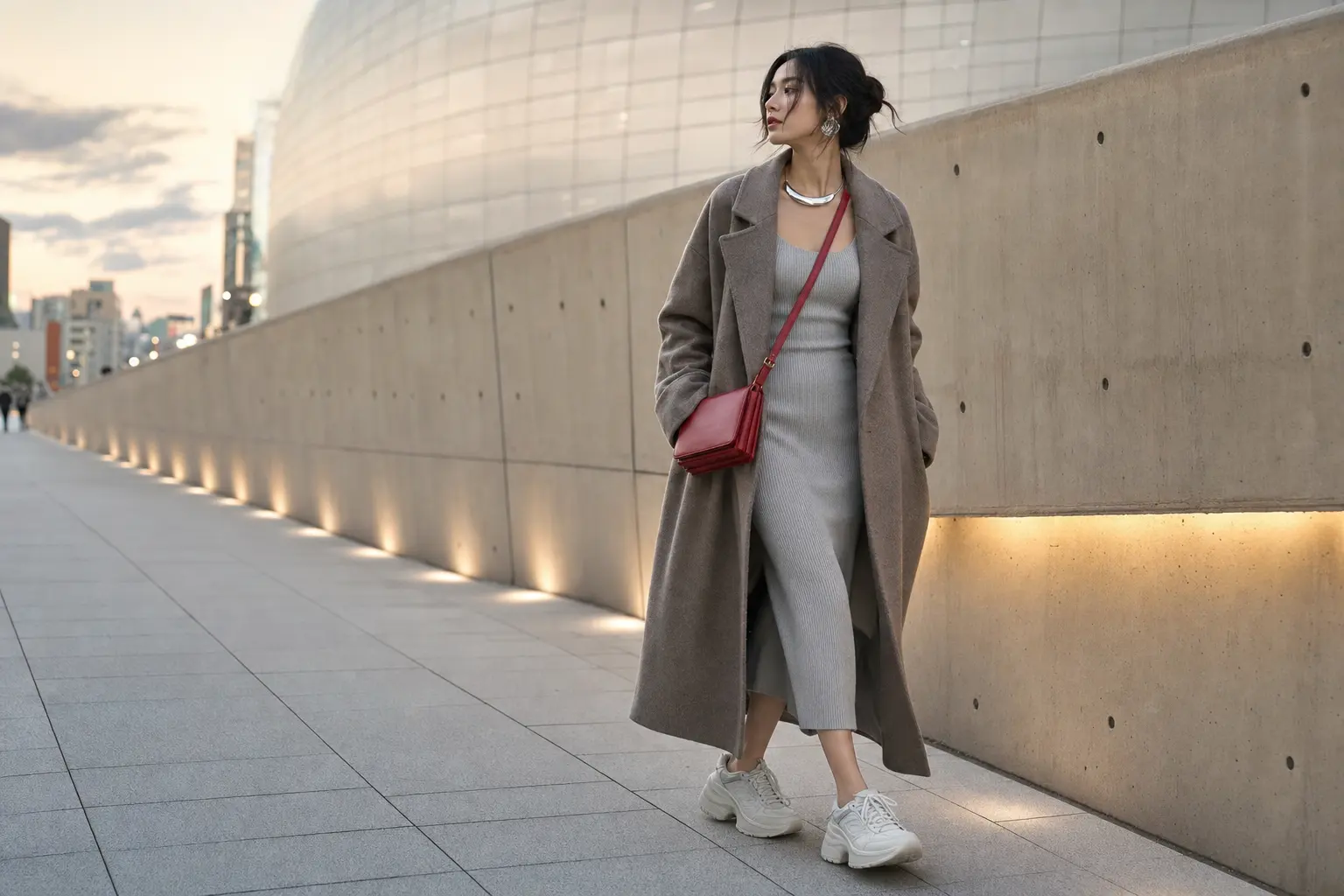
Seoul Fashion Week trends have shifted fast: the 2025–26 seasons balanced oversized, technical streetwear with a parallel body‑con and see‑through moment, and designers leaned into sustainability and Seoul identity. This article decodes those runway cues and shows you exactly how to wear them.
Expect specific, usable advice—what to buy, how to layer, how garments should hang and where to spend—plus where to watch shows and which Korean wardrobes translate globally.
Why Seoul Fashion Week Matters Now
Seoul Fashion Week is a biannual, city-supported platform that has moved from a local industry showcase to a clear trade-and-export engine. The programme schedules runways, presentations and showrooms across multiple venues—DDP remains a key hub—and the municipal organisers explicitly framed the 2026 S/S season as a 25th‑anniversary edition of the event with international collaborations such as the Berlin Showroom tie‑in [2]. That institutional backing means the event is designed for buyers and press as much as it is for culture: trade pavilions, buyer-facing platforms and curated showrooms are part of the business model now [6].
Why that changes what you wear: when a city-run fashion week doubles as a trade show, designers begin to present pieces that are easier to buy and distribute—clear silhouettes, repeatable colorways, and signature accessories that travel. In 2025–26 you can see that tension: experimental runway moments coexist with wholesale-friendly staples that buyers can translate into stores [4]. For the street, this creates a rapid loop: runway cue arrives in showroom, buyers order, and within months the look is on Seoul streets and global e-commerce feeds.
Practically, you should pay attention to what buyers pick at the showrooms. Those pieces become the wardrobe vocabulary for the season. If a material or silhouette turns up across several labels in showroom photos or buyer roundtables, it’s not just a designer statement—it’s a wholesale signal that will shape retail offerings later in the season [6][2].
Key Looks on the Runway: Four Motifs to Know
Across the F/W 2026 and S/S 2025–26 cycles, a set of repeat motifs kept reappearing: oversized layering and wide trousers, performance/technical streetwear, a contrasting body‑con and see‑through thread, and maximalist finishing details for colder seasons such as fur collars and pronounced bows [3][7]. Understanding each motif—and how they pair—lets you adopt selective elements without committing to an entire runway silhouette.
Oversized layering
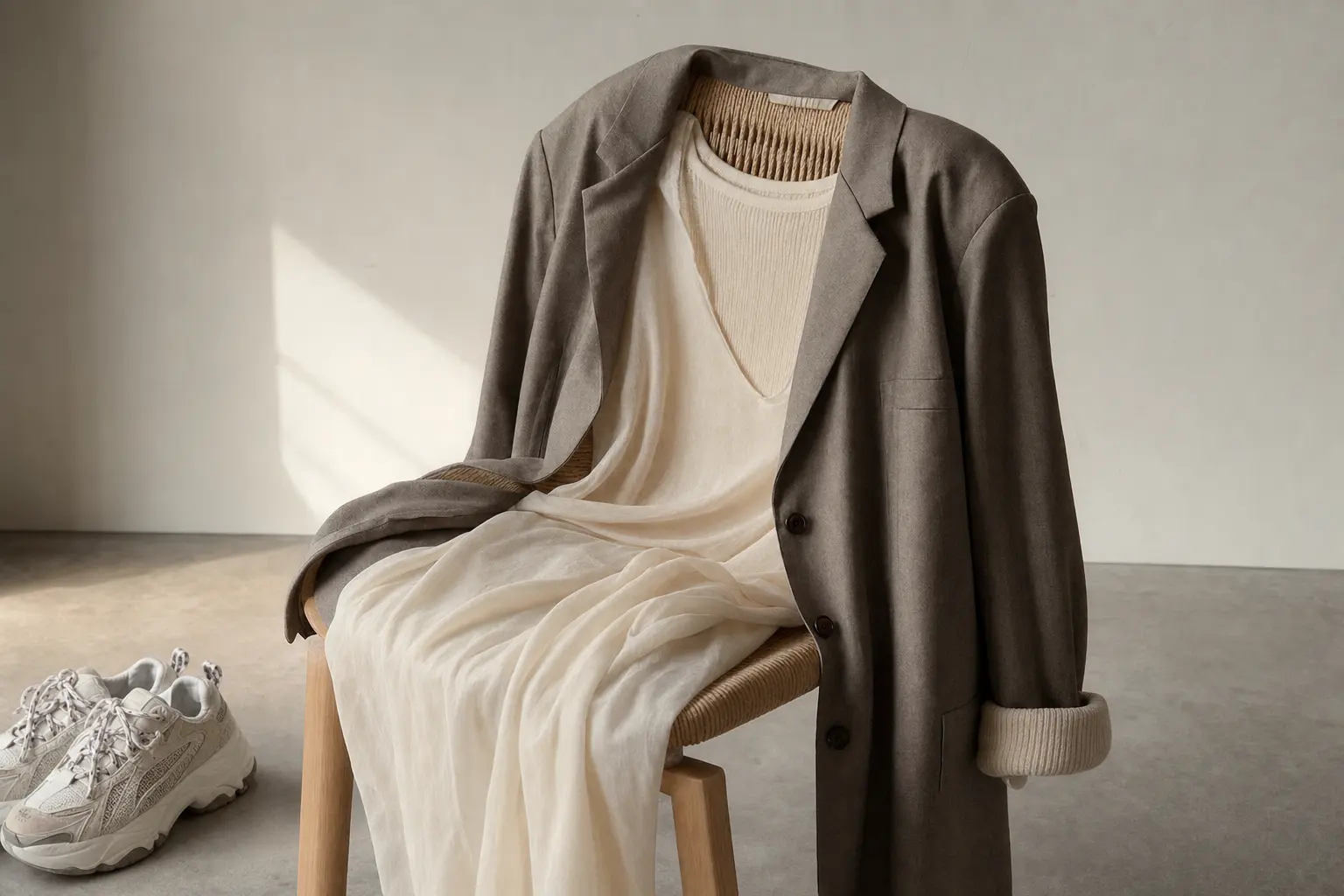
Runs from open oversized blazers over longline tees to multi-layered outerwear where proportion is the point. The look demands structure under volume: choose a fitted base (a ribbed tee or slim knit) and place one volume piece on top—think a boxy coat or wide-leg trousers. Sleeve lengths should fall to the wrist bone or just past; if the sleeve covers the hand by more than 2–3 cm, expect to roll or cuff on purpose to reveal a base layer.
Performance and technical streetwear
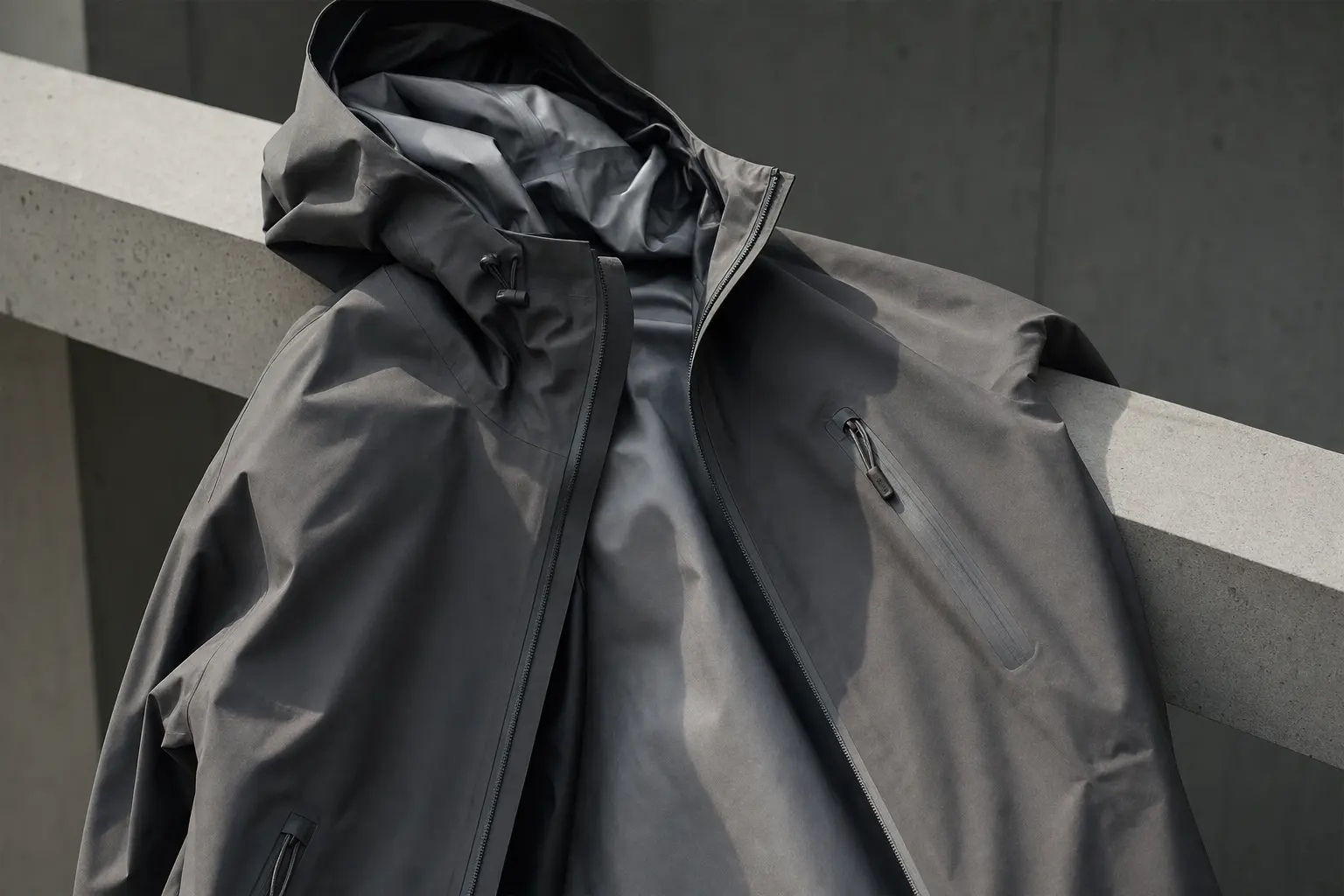
Fastened zips, taped seams, and water‑repellent or breathable membrane fabrics appeared as designers borrowed from activewear tech. This is not neon sportswear; it’s subtle—matte finishes, layered ventilation, and utilitarian pockets. Look for tapered cuffs, articulated knees, and layered hoods. These garments want one technical accessory: a thick-soled sneaker and a compact crossbody; combine matte nylon with brushed cotton so the textures don’t clash.
Body‑con and transparency
SS street style pushed a see‑through, catsuit-adjacent silhouette at odds with the oversized trend. Use this as a contrast tool: a slim, semi-sheer layer under an oversized coat or blazer reads contemporary rather than clubwear. Opt for textiles with a soft matte sheen—fine modal blends over plastic synthetics—so the silhouette reads as intentional and tailored.
Maximalist finishing details
F/W 2026 showed extravagant bows, faux fur collars and jewel-like hardware as punctuation marks. These are the accents that turn an otherwise quiet outfit into a statement. Use one at a time; a fur collar plus maximalist jewelry is a heavy hand unless you’re aiming for editorial excess [3].
Silhouette Battles: How to Choose Between Oversize, Slim, and Technical
The most useful question to ask when shopping SFW-inspired pieces is: what role will this garment play in my wardrobe? Seoul designers staged three dominant silhouette approaches across recent seasons—oversized, body‑skimming, and technical—each with distinct proportions, layer rules, and tailoring pitfalls. Picking the right one depends on how much volume you already own, your tolerance for tailoring adjustments, and the climate in which you live.
Below is a quick comparison you can use while shopping. Use the chart to match silhouette with season, fabric cues and the simplest styling trick that makes each silhouette work in daily life.
| Silhouette | Season & Use | Fabric cues | Styling shortcut |
|---|---|---|---|
| Oversized layering | F/W primary; cool springs. City commuting and layered looks. | Brushed wool, heavyweight cotton, technical blends for outerwear. | Pair with slim base; tuck one piece (front tuck) to define waist. |
| Body‑con / semi‑sheer | Spring–Summer; eventwear and street-style contrasts. | Stretch modal, fine mesh, nylon-mica blends. | Wear under an oversized blazer to balance proportion. |
| Technical streetwear | All-season utility; best for wet or active days. | Matte nylon, coated cotton, bonded seams. | Limit to one statement technical piece; keep rest neutral. |
Common mistakes: buying oversized garments without thinking about length is the most frequent. An oversized blazer that ends mid‑thigh on a shorter frame reads sloppy; instead pick cropped or structured longlines that finish at the hip or just below. For body‑con pieces, avoid transparent fabrics that reveal seams or cheap linings—look closely at interior finishing before you buy or plan to layer a slip for cleaner lines.
When trying on technical garments, test movement: squat, reach and walk briskly. Panels should not pull or balloon; zips should close smoothly with one hand. If a taped seam creases visibly, that piece will show wear quickly—consider a higher‑density fabric or go one size up and tailor the shoulders.
Materials, Sustainability and Seoul's Design Identity
The recent SFW programming emphasized sustainability and materials innovation as part of trade outreach and brand strategy: upcycled denim, circular design cues, and reinterpretations of traditional Korean textiles appeared in showrooms and pavilion displays [6][2]. Buyers and curators are looking for traceable inputs and repeatable fabrication tactics that scale to wholesale orders—so designers emphasize modularity and repairability in addition to visual detail.
What to look for in a purchase: seams that are double-stitched in high‑stress areas, hems with visible reinforcement and fabrics that explicitly state fiber content and origin. Upcycled denim often has visible patchwork but should also show consistent internal finishing—check for over-adhesive patches or raw edges that will fray with washing. If labels promise natural dyes or traditional weave techniques, inspect for rubbing fastness: dark indigo that rubs off on the skin suggests insufficient dye fixation.
How Seoul designers make sustainability practical
Design studios showcased three practical strategies: reuse and visible repair, modular garments that can be reconfigured by the wearer, and material mixes that reduce reliance on virgin synthetics. For example, a coat might use a recycled polyester shell and a cotton-lining panel that can be detached and washed separately. These are not abstract statements; they are construction choices you can feel—heavier seams where panels join, brass snaps instead of glued trim, and interior labels explaining care.
When a brand uses upcycled denim, ask whether the piece uses stock denim from previous seasons or textile waste; the first is more defensible in quality control. At the showroom level, buyers asked for grading instructions and wash recipes so garments arrive consistent across sizes—if a label can provide those, it’s a sign the sustainability claim is backed by process rather than PR.
Finally, Seoul identity appeared not as literal hanbok references but as proportion and restraint: a sense of tailoring that emphasizes shoulder clarity and sleeve length combined with experimental textures. That aesthetic subtlety is what often separates a trend-driven item from a lasting wardrobe piece.
Accessories and Footwear: The Finishing Rules
Accessories were the punctuation marks at recent SFW shows: thick, sculpted jewelry, compact crossbody bags, and chunky/dad sneakers were constants. For F/W, designers specified maximal collars—faux or trimmed—with bows and implemented ornamental hardware that reads like jewellery on clothing [3]. The trick is restraint: the runway invites exuberance, but most street implementations use one bold accessory at a time.
Shoes—how to choose
Chunky sneakers continue to dominate for 2025–26. Look for a sole that is 30–45 mm in thickness for the visible platform effect without wobble. Leather uppers with a matte finish pair more easily with technical nylons than glossy leather does; matte rubber soles also photograph better in city light. When trying pair-on, test heel slip: your heel should not lift more than 1 cm on brisk walks. Anything more requires insole adjustments or a size change.
Bags and small accessories
Crossbodies and compact satchels were the showroom seller: pick one with structured base and a tactile strap to balance oversized clothing. For leather, look for a pebble grain that hides scratches; for nylon, expect tight weaving and reinforced stitch points. Metal hardware should be solid and weighted—light hollow hardware is a tell for cheap construction.
Jewelry & finishing touches
Chunky chains and sculptural rings were used selectively; choose one statement piece per outfit. If you add a large collar (fur or faux fur), skip heavy necklaces to avoid competing focal points. A single brooch or bar pin applied to lapel or collar provides editorial lift with minimal fuss.
How to Translate Seoul Fashion Week Trends into Your Wardrobe
Translating runway ideas into everyday wear is about extracting one clear element and building around it. Start small: pick one silhouette cue (wide trousers, technical jacket, or slim semi‑sheer top) and two practical supporting pieces. This reduces shopping waste and keeps outfits coherent.
Step-by-step styling rules
- Choose your anchor piece: a wide-leg trouser or a technical shell. Buy with fit in mind—waist and crotch must be correct; length can be altered. If you’re between sizes for volume, opt larger for trousers but plan tailing at the hem.
- Select a fitted base: a crew-neck rib tee or a slim knit that sits at the hips. For body‑con elements, choose a fabric with 10–15% elastane for recovery and comfort.
- Add one voluminous layer: cropped bomber, oversized blazer, or longline coat. Aim for a sleeve length that reaches the wrist or 2–3 cm past; if it covers the hand entirely, plan a purposeful cuff.
- Balance with footwear: chunky sneakers or a sleek ankle boot. For trousers with long hems, choose a heavier sole to avoid dragging. For short cropped trousers, lace-up low profiles work.
- Finish with one bold accessory: sculptural ring, compact crossbody, or a pronounced collar. Keep the rest minimal.
Example outfit prescriptions (exact items and proportions): For city commuting, match a midweight oversized wool coat (shoulder seam at the natural shoulder, length just above the knee) with 1 fitted rib tee, 1 pair of 2 cm cuffed wide trousers (full circumference reduced by 4–6 cm at the hem if needed), and chunky sneakers with a 35 mm sole. Add a compact crossbody bag worn high on the torso to keep the silhouette tidy.
For a night edit, reverse the rule: slim mesh or modal dress under an oversized blazer; keep jewelry heavy but singular, and add a sculptural clutch. Use layering to transform the same blazer from daytime utility to evening statement.
For reference on idol and airport aesthetics that often borrow from SFW street style, see the StyleMZ take on Korean airport fashion: Korean Airport Fashion Looks — How Idols Travel in Style.
Sizing, Fit Norms and Korean Streetwear Practicalities
Korean sizing norms and fit expectations differ from Western standards in two predictable ways: proportion and sleeve/hem length matter more than absolute numeric size, and many K‑streetwear pieces are intentionally graded for a layered silhouette. That means a size labelled “M” might have a different shoulder slope or back length than the M you’re used to—always check the garment’s measurements in centimeters and compare against a baseline piece that fits you.
Exact measuring checklist before you buy online
- Shoulder width: measure seam-to-seam across a well-fitting jacket—this determines shoulder fit more than chest measurement.
- Chest/waist flat measurement: lay the garment flat, double the chest measurement. If it’s an oversized piece, expect +10–30 cm over your chest circumference depending on intended volume.
- Sleeve length: measure from shoulder seam to cuff. For an oversized look with purposeful cuffing, subtract 2–3 cm from the listed length to visualize the rolled finish.
- Total length: front and back lengths determine where the hem will sit—mid-thigh? Hip? Use these numbers to plan proportions.
Alterations you will need: widening or narrowing trousers at the hem is a common tailor job—add 1–2 cm to seam allowances if you plan to let the hem down. Shortening an oversized coat is easy if the lining allows it; slimming shoulder width requires a more involved tailor and is best avoided unless the piece is expensive enough to justify the work.
Fit tests for technical pieces: move in the garment—reach forward, bend knees. If the fabric or seam pulls across the back or the crotch, try a different size or a cut with articulated seams. For layered oversize, test the garment over the base layers you plan to wear; an oversized shell measured alone can look fine but feel restrictive when layer count increases.
When in doubt, size for your largest intended layering and plan to tailor the shoulders or hem. Korean streetwear shops often include precise flat measurements; use them and treat numbers as non-negotiable data rather than size labels.
Where to Watch, Buy and Follow Seoul Fashion Week
Watching SFW: Seoul Fashion Week shows and presentations are often covered by event livestreams, brand channels and trade partners during the scheduled windows. Keep an eye on official municipal communications for dates—the 25th‑anniversary S/S 2026 programming ran in early September as a longer festival of shows and a Berlin Showroom collaboration [2]. F/W shows took place in early February with heavy press coverage of extravagant details like fur collars and bows [3].
Buying: Some K‑designers sell internationally through e‑commerce or selected stockists; larger names and labels often provide international shipping or have European/US distribution networks. For an editorial primer on designers, see our roundup: Korean Fashion Brands to Know: A Designer-Forward Guide.
Practical shopping tips
- If a brand offers a showroom appointment, ask for graded measurements and wash instructions before committing to an order.
- Check return policies carefully—cut-and-sew pieces and small-run designer items may have final sale terms.
- Plan for customs and duties if ordering internationally; smaller brands sometimes price with expected export costs in mind.
Follow the right feeds: trade press captures the wholesale moments that become retail hits; street-style photographers capture the wearable looks that will translate to fast-turn pieces. Use a mix: trade channels for material and sustainability cues, street-style for proportion and real-life fit ideas.
For styling inspiration that overlaps with SFW street moments, our Minimalist K‑Pop style pieces explain how to scale performer aesthetics into daily wear: How to Dress Like a Korean Idol: Minimalist K‑Pop Style Guide. Also check our curated categories for new drops and capsule pieces in the shop: New Arrivals.
Final watching note: because SFW programming is now overtly trade-focused, many shows are paired with showroom windows—if you want to predict what will be in retail later, follow showroom announcements and trade pavilion highlights [6].
Shop the collection: Korean graphic tees, Korean long sleeve shirts, Korean sweatshirts, Korean hoodies and Korean tank tops – original graphics designed in Korea, made to order.
Frequently Asked Questions
When are the S/S and F/W Seoul Fashion Week dates each year?
Seoul Fashion Week runs twice a year—spring/summer and fall/winter—typically in early February for F/W collections and late August to early September for S/S presentations. The 2026 S/S season was scheduled as a special 25th‑anniversary run in early September [2], while F/W shows were staged in early February 2026 [3].
How can I watch Seoul Fashion Week shows and livestreams?
Official event platforms and designer channels often stream shows during the scheduled programme. Also monitor trade partners and press outlets for livestream windows, and check brand social channels for delayed uploads. Showrooms and pavilions may publish lookbooks and buyer videos shortly after live dates [2][6].
Are Seoul Fashion Week brands focusing on sustainability?
Yes. Recent programming highlighted sustainability, circular design and material innovation, especially in trade pavilion presentations and buyer-facing showrooms. Look for visible repair, modular design elements and explicit fiber and wash information when brands claim upcycling or recycled content [6].
How do I know which silhouette (oversized vs body‑con) will suit me?
Pick one dominant silhouette per outfit and balance it with a contrasting base: oversized outerwear needs a slim base layer; body‑con pieces pair best with a structured coat or blazer. Use garment measurements rather than size labels and plan minor tailoring for hem length or shoulder adjustments if needed.
Which Korean designers from SFW are most visible internationally?
Several Korean designer labels have raised international profiles in recent seasons; notable names are frequently referenced in press and trade coverage. For an editorial guide to designers and how they translate to shopping, see our designer roundup for context and direct buying links: Korean Fashion Brands to Know: A Designer-Forward Guide.